Why Your DOTS or IPF GL Score Changes Between Meets Even With the Same Total
Adrian Callen
Last updated
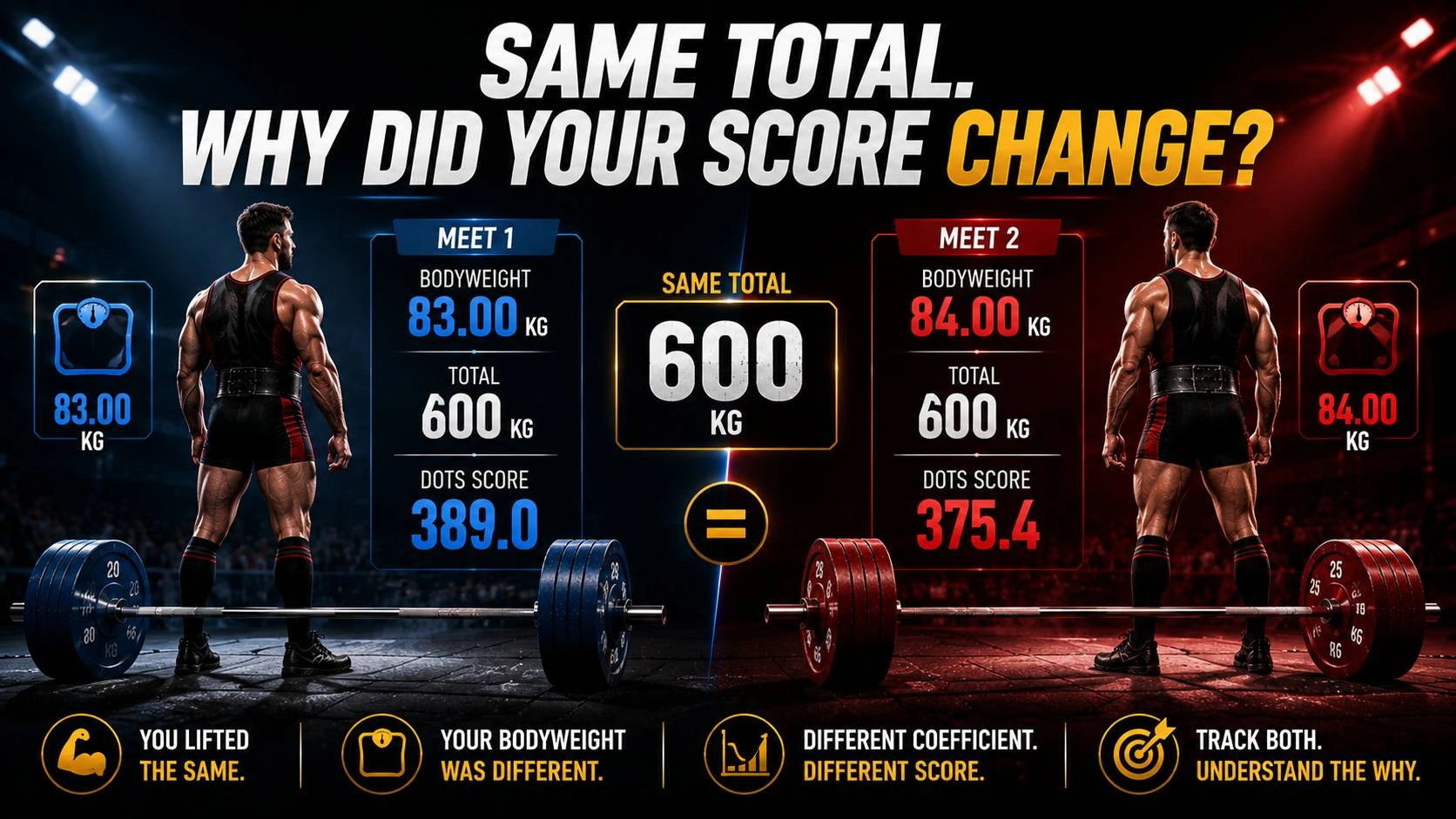
You hit the same total at two consecutive meets. Your score came back different both times.
Nothing changed in your lifting. Something changed in your number. Here is exactly why.
Can your score change without your total changing?
Yes. Your score depends on two inputs: your total and your bodyweight. If your bodyweight changes between meets, your score changes too. Even a 1 kg difference in weigh-in bodyweight produces a different coefficient, which produces a different final score.
The math behind it
Your total gets multiplied by a coefficient calculated from your bodyweight. That coefficient is not fixed. It shifts continuously with every kilogram of bodyweight. A heavier weigh-in produces a lower coefficient. A lighter weigh-in produces a higher one.
How much does bodyweight affect your score?
The impact varies depending on where you sit on the bodyweight curve. For most lifters in middle weight classes, a 1 kg bodyweight difference shifts the score by roughly 2 to 5 points.
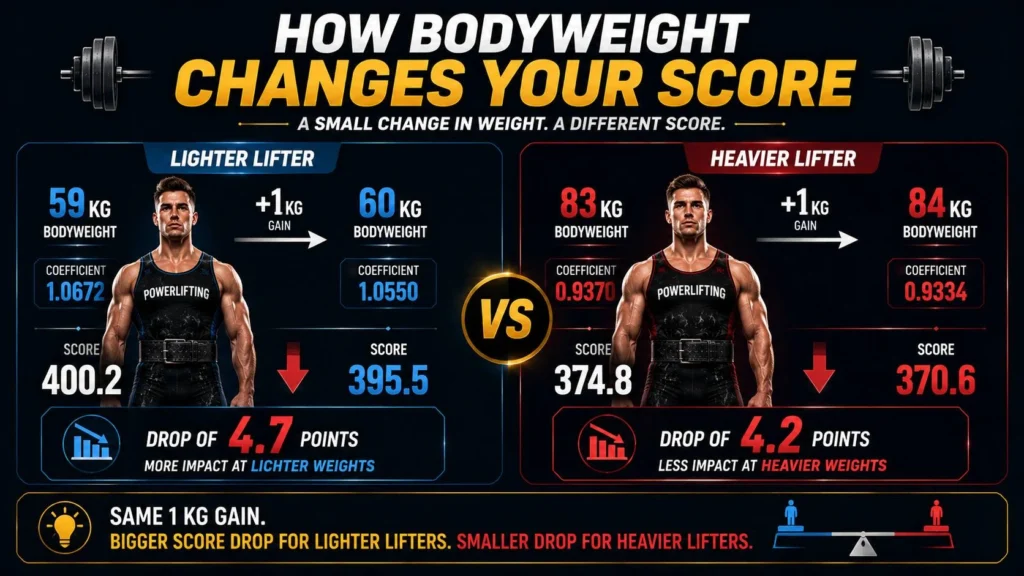
Where the shift is largest
Lighter lifters see bigger coefficient changes per kilogram than heavier lifters. A 59 kg lifter gaining 1 kg loses more score points than an 83 kg lifter gaining the same 1 kg. This is a direct result of how the polynomial coefficient curve in DOTS and the exponential curve in IPF GL are shaped.
Does the scoring formula ever change between meets?
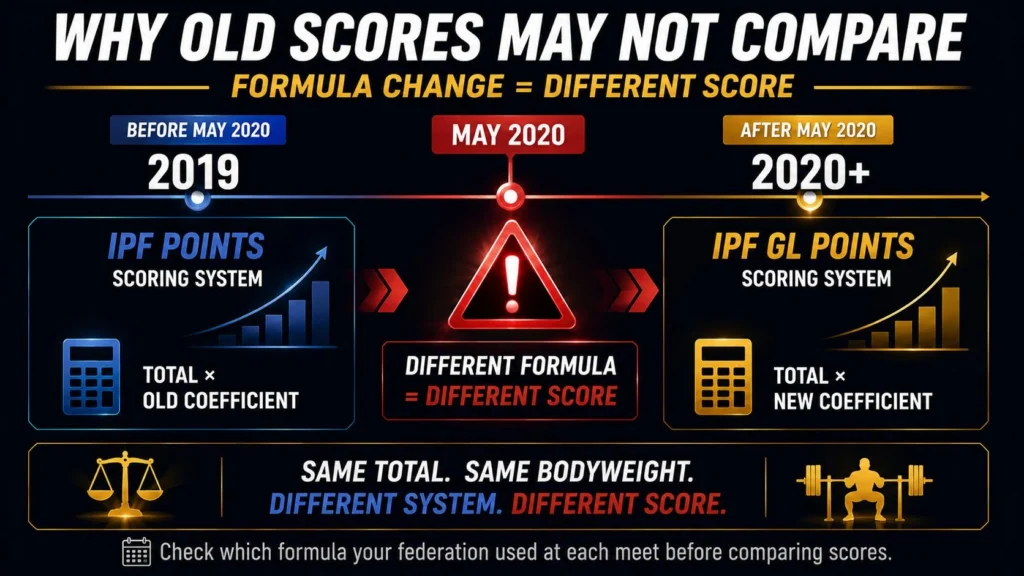
Sometimes. Federations occasionally update their official scoring formula. The IPF switched from IPF Points to IPF GL Points in May 2020. Any lifter who competed before and after that date saw their scores recalculated under a different formula on the same total.
How formula updates affect historical comparison
If your federation changed its scoring system between two meets, your scores are not directly comparable. A 380 under the old formula and a 380 under the new formula may represent different levels of performance depending on which system was used.
The full history of how scoring systems evolved explains exactly when each major formula change happened and which federations were affected.
What if your total and bodyweight both stayed exactly the same?
Your score should be identical under the same formula. If it is not, check three things. First, confirm which formula was used at each meet. Second, check whether your bodyweight was recorded differently, even by a fraction. Third, verify whether the meet used pounds or kilograms for the official weigh-in record.
Unit conversion errors
A lifter who weighed in at 183 lbs at one meet and 83 kg at the next may appear to have the same bodyweight, but the conversion produces a slight difference. 183 lbs equals 83.01 kg. That fraction shifts the coefficient enough to produce a different score at the decimal level.
How does water cutting affect this between meets?
Water cuts affect your official weigh-in bodyweight directly. A lifter who cuts 3 kg for one meet but only 1 kg for the next will weigh in at different bodyweights even if their normal training weight is identical.
That difference in official bodyweight produces different coefficients and different scores even when the total lifted on the platform is the same.
What this means for score tracking
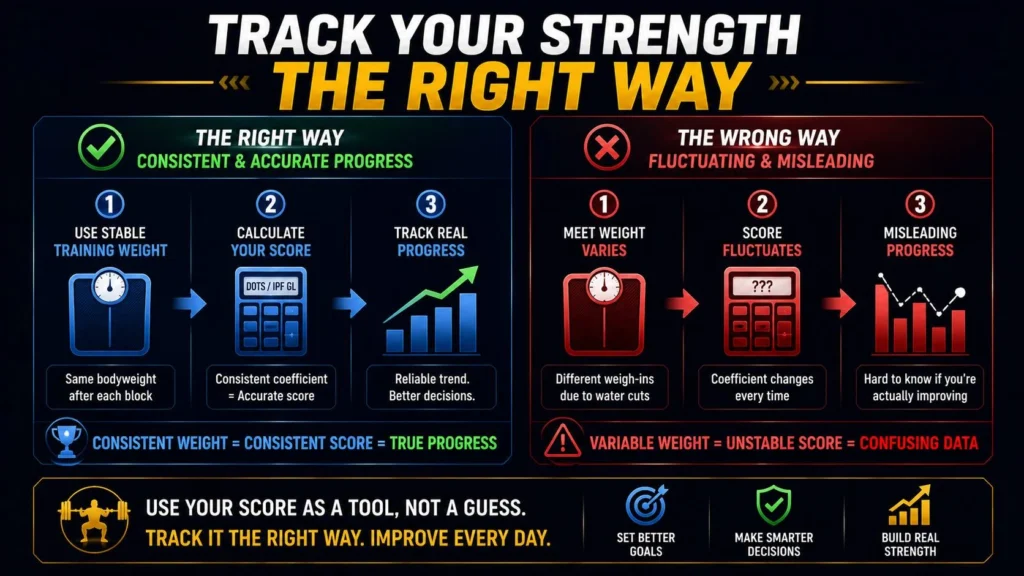
Never compare scores from meets where your weigh-in bodyweight differed significantly. The most accurate way to track your progress is to compare scores from meets where your bodyweight was consistent. Alternatively, use your stable training bodyweight in the DOTS and Wilks calculator to produce a consistent benchmark outside of competition conditions.
Should you track your score between meets using your training weight?
Yes. Calculating your score at a consistent training bodyweight after each training block gives more useful progress data than comparing fluctuating competition weigh-ins.
Your competition score reflects your official meet performance. Your training score reflects your underlying strength trend. Both are useful, but they answer different questions.
Lifters who use their score as a goal-setting tool get the most value from tracking both numbers separately and understanding what each one tells them.
Frequently asked questions
Why is my DOTS score different at two meets with the same total?
Your bodyweight changed between meets. Even a 1 kg difference in weigh-in weight produces a different coefficient and a different final score.
Can a formula change cause my score to change?
Yes. If your federation updated its scoring formula between meets, scores from before and after are not directly comparable even at the same total and bodyweight.
How much does 1 kg of bodyweight change my DOTS score?
For most lifters in middle weight classes, 1 kg of bodyweight shifts the score by roughly 2 to 5 points depending on where you sit on the coefficient curve.
Should I use my competition weight or training weight to track progress?
Use your stable training weight for consistent progress tracking. Competition weigh-in weights vary due to water cuts and can distort your score trend.
What if my score dropped but my total went up?
Your bodyweight likely increased by more than your total improvement. A rising total with a rising bodyweight can produce a flat or lower score if the bodyweight gain outpaces the strength gain.
Same Total, Different Number
Your score is not just about how much you lift. It is about how much you lift relative to what you weigh on the day.
Track both your total and your weigh-in bodyweight after every meet. That combination tells the full story behind every score change.
Check how your numbers interact right now using the powerlifting scoring calculator.