How Powerlifting Scoring Evolved: From Schwartz and Malone to DOTS and IPF GL
Adrian Callen
Last updated
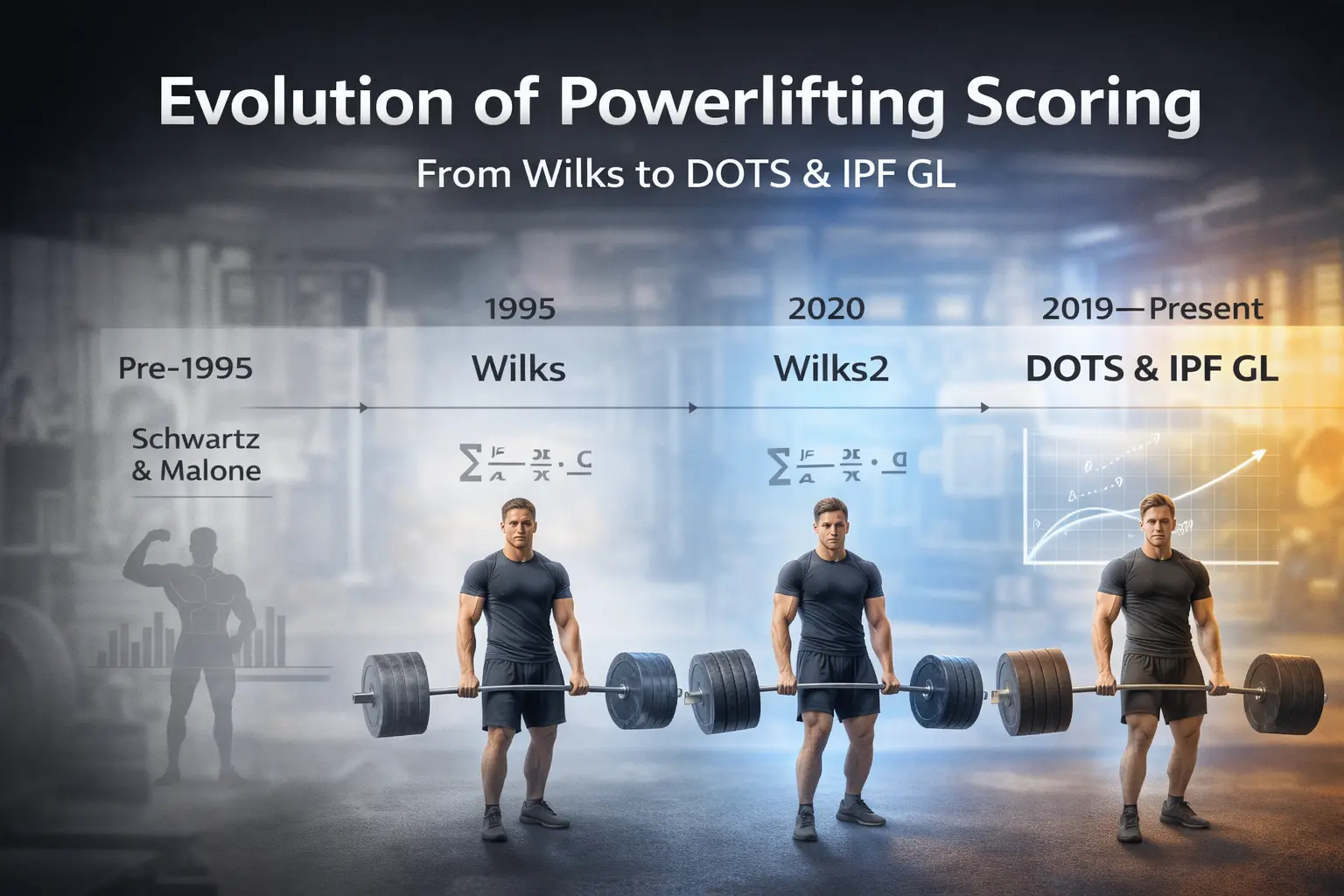
Powerlifting has always needed a way to answer one question: who is the strongest lifter at this meet, regardless of bodyweight?
The sport has been working on that answer for decades. Each scoring system that emerged was a response to problems with what came before it.
Where did powerlifting scoring start?
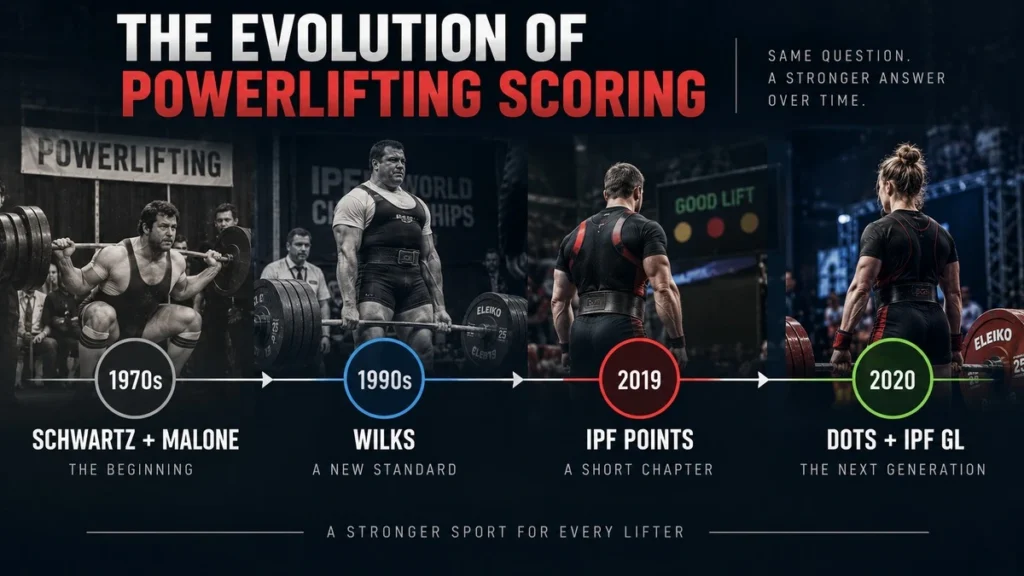
The earliest widely used formulas were the Schwartz formula for men and the Malone formula for women. Dr. Lyle Schwartz developed his formula in the early 1970s, fitting a curve to competition data so lifters of different sizes could be compared. Pat Malone created a parallel formula for women, used from around 1979 onward, after recognizing that applying the men’s coefficients to female lifters produced unfair results.
Both formulas were a genuine step forward. But they were built on limited data from an era when powerlifting was still a young, unevenly developed sport. The Schwartz formula was criticized for favoring lighter lifters, and neither system handled extreme bodyweights well. As the sport grew, the need for something more statistically rigorous became harder to ignore.
Why did Wilks replace Schwartz and Malone?
Robert Wilks, CEO of Powerlifting Australia, developed the Wilks coefficient in the mid-1990s using IPF equipped competition data from roughly 1987 to 1994. The formula was validated against world record holders at the 1996 and 1997 IPF World Championships.
Wilks used a fifth-degree polynomial, a more complex mathematical structure than what came before, and produced separate coefficient sets for male and female lifters. It was adopted by the IPF and spread quickly across affiliated national federations. For a substantial part of powerlifting’s modern competitive history, Wilks was the standard way to determine best lifter awards and cross-weight-class comparisons.
It was not universally adopted everywhere, and some federations used their own systems. But Wilks was the most widely recognized benchmark the sport had seen.
What were the problems with Wilks?
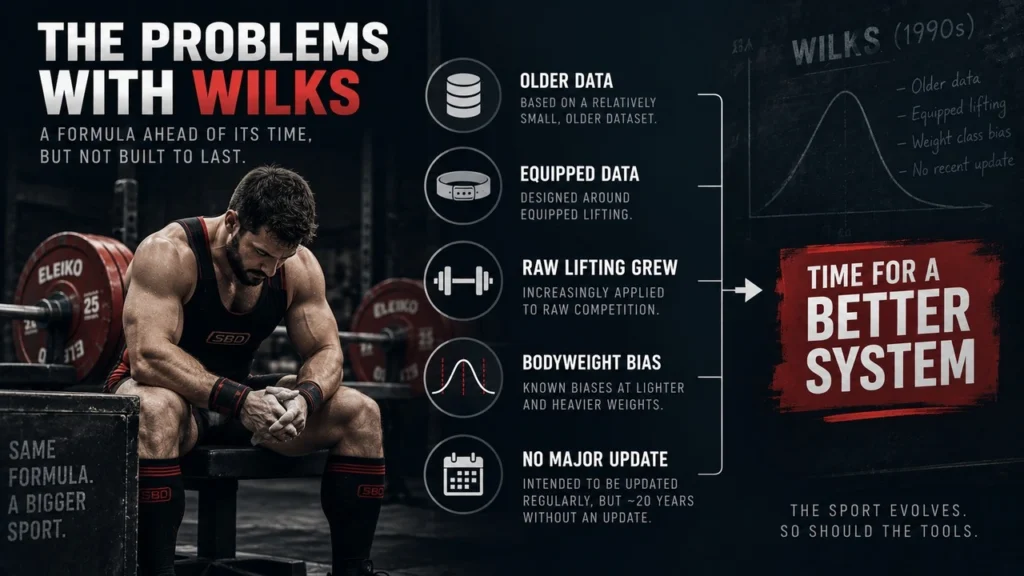
The original Wilks formula was fitted to equipped competition data from a relatively small dataset collected decades ago. As the sport grew, particularly in raw powerlifting, the formula’s limitations became more visible.
Research identified biases at lighter and heavier bodyweights. The formula was also designed around equipped lifting, but was increasingly applied to raw competition, a different physical context with different strength distributions. Critics pointed out that certain weight classes were systematically over- or under-rewarded.
The formula’s author had intended it to be updated every few years, but no official update came for roughly two decades.
How did the IPF respond?
The IPF’s relationship with Wilks ended at the close of 2018. In January 2019, the federation introduced its own replacement: IPF Points, the first formula the IPF developed internally. It accounted for equipment type and lift type, which Wilks had not.
IPF points did not last long. In early 2020, the IPF published an independent evaluation of five major scoring systems. That evaluation compared each formula on consistency across weight classes and accuracy in ranking equivalent performances.
The results placed IPF GL Points first, DOTS second, Wilks2 third, and the original Wilks toward the bottom of several categories. In May 2020, the IPF replaced IPF Points with IPF GL Points.
IPF GL, where GL stands for Goodlift, uses an exponential curve fitted to world record data, a different mathematical approach from the polynomial-based systems that came before it.
What is DOTS and where did it come from?
Tim Konertz, a statistician affiliated with the German Powerlifting Federation, published the DOTS formula in 2019. He built it on a larger and more recent competition dataset than Wilks, using a fourth-degree polynomial designed to produce more consistent scores across the full bodyweight range. The DOTS formula uses bodyweight and total to produce the final score.
DOTS was not developed by the IPF. It was an independent response to the same problems that were prompting the IPF to seek alternatives. Several major non-IPF federations evaluated it and moved away from Wilks relatively quickly. USPA officially adopted DOTS in 2020. WRPF and several other federations followed between 2020 and 2021.
The IPF did not adopt DOTS. It developed IPF GL in parallel, and the two systems ended up in different parts of the federation landscape. DOTS in non-IPF federations and IPF GL in IPF affiliates.
What is Wilks2 and why does it matter?
In March 2020, the same month the IPF evaluation was published, Robert Wilks released an updated version of his original formula. This revision, called Wilks2 or Wilks 2020, kept the same polynomial structure but recalibrated the coefficients to reduce the known biases at lighter and heavier bodyweights.
Wilks2 ranked third in the IPF’s 2020 evaluation, ahead of the original Wilks. Powerlifting Australia adopted Wilks2 as its official formula. For lifters in federations that use the original Wilks or Wilks2, historical results remain meaningful and can be compared across time using whichever version the federation applied.
Where does scoring stand today?
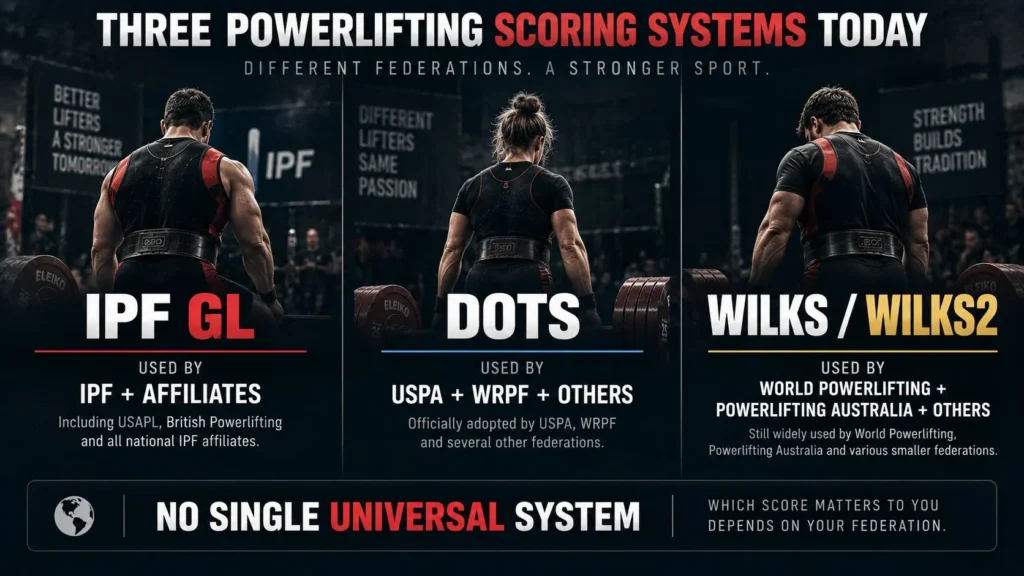
The sport currently operates under three main systems used by different sets of federations:
The IPF and all national IPF affiliates use IPF GL Points, including USAPL in the United States and British Powerlifting in the UK. The formula is based on an exponential curve and is recalibrated against world record data.
USPA, WRPF, and several other non-IPF federations use DOTS for best lifter awards and cross-weight-class comparisons.
Wilks/Wilks2 is still used by World Powerlifting, Powerlifting Australia, and various smaller federations. Wilks remains the most historically significant formula in the sport, with decades of competitive results calculated under it.
No single system is universal. Which score matters to you depends entirely on which federation you compete in, and which powerlifting federations use DOTS, Wilks, or IPF GL can vary.
Frequently asked questions
Why did powerlifting need scoring formulas at all?
Raw totals always favor heavier lifters in absolute terms. Scoring formulas adjust for bodyweight so lifters of different sizes can be compared fairly on relative strength.
When did the IPF stop using Wilks?
The IPF used Wilks until the end of 2018. It introduced its own IPF Points formula in January 2019, then replaced that with IPF GL Points in May 2020.
What was the IPF 2020 evaluation?
The IPF commissioned an independent comparison of five scoring formulas. IPF GL ranked first, DOTS second, Wilks2 third, and original Wilks toward the bottom in several categories. The evaluation led directly to the adoption of IPF GL.
Does Wilks still count for anything?
Yes. Historical results calculated under Wilks are still valid for comparison within the same system. Several federations continue using Wilks or Wilks2 officially today.
A sport still evolving
Powerlifting scoring has changed more in the last decade than in the previous thirty years. The shift from Wilks to DOTS and IPF GL was not just administrative. It reflected a sport that had grown beyond what its original tools could measure accurately.