What Is a Good DOTS or Wilks Score? Benchmarks by Level
Adrian Callen
Last updated

You just calculated your score. Now you want to know what the number actually means.
There is no single universal answer. What counts as a good score depends on your sex, weight class, equipment division, and federation. But there are community reference points that give useful context.
What do DOTS and Wilks scores measure?
Both are relative-strength scores that adjust your powerlifting total for your bodyweight. A higher score means stronger performance for your size, regardless of which weight class you compete in.
The DOTS score and Wilks score use different formulas and different datasets. They produce scores in a similar numeric range for most lifters, but they are not directly interchangeable. A 380 DOTS and a 380 Wilks do not represent identical performances. The two systems will often produce different numbers for the same lifter.
What are the DOTS score benchmarks?
The ranges below are rough community reference points based on patterns across competitive results. They are not official federation standards and will vary by sex, weight class, equipment, and federation.
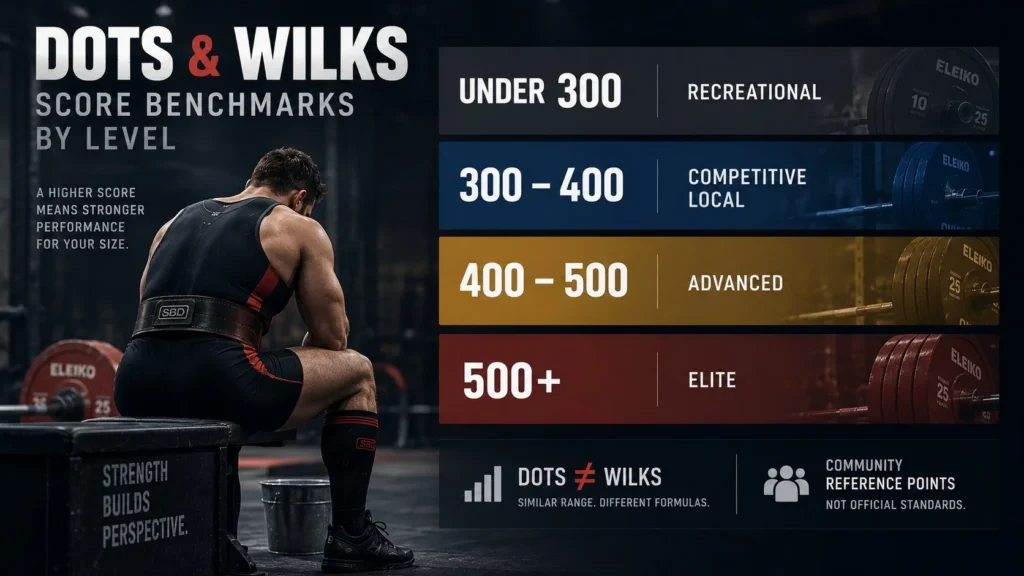
A score around 300 is broadly associated with competitive ability at the local level. Scores around 400 are widely treated as a meaningful advanced milestone. Above 500 is broadly described as elite. These are patterns observed across the community, not thresholds set by any federation.
What is a good DOTS score for a newer lifter?
Progress varies too much between individuals to set a reliable milestone in a fixed timeframe. A rising score across training blocks is the most useful signal. It means your total is growing faster than your bodyweight. The absolute number matters less than the direction it moves over time.
What are the Wilks score benchmarks?
Wilks benchmarks follow a similar pattern to DOTS. The ranges below are rough community reference points. As with DOTS, they are not official federation standards.
| Level | Wilks (approximate) |
| Recreational | Under 300 |
| Competitive local | 300 – 400 |
| Advanced | 400 – 500 |
| Elite | 500+ |
As with DOTS, these are approximate community reference points. Wilks scores can differ from DOTS scores for the same lifter depending on bodyweight and total.
Are DOTS and Wilks scores on the same scale?
Not exactly. Both systems produce numbers in a broadly similar range, but they use different formulas calibrated on different datasets. The full comparison of DOTS, Wilks, and IPF GL explains where the systems agree and where they diverge.
Do not assume your DOTS score translates directly to an equivalent Wilks score. Calculate both separately if you need both numbers.
Do scores differ for men and women?
Both DOTS and Wilks use separate coefficient sets for male and female lifters. The score scales are designed to produce comparable numbers across sexes. In practice, how well that comparability holds varies by the specific formula and bodyweight range.
Does equipment affect the benchmarks?
Equipped lifting allows higher totals at the same bodyweight, which produces higher scores under both systems. The formula itself does not change for equipped lifting. The same polynomial applies. Because of this, equipped and raw scores should not be compared directly. Always use benchmarks within the same equipment category.
How should you use your score over time?
Your score is most useful as a progress tracker. A score that rises across training cycles means your strength is improving relative to your bodyweight. A flat or falling score during a period of weight gain suggests mass is accumulating faster than strength.
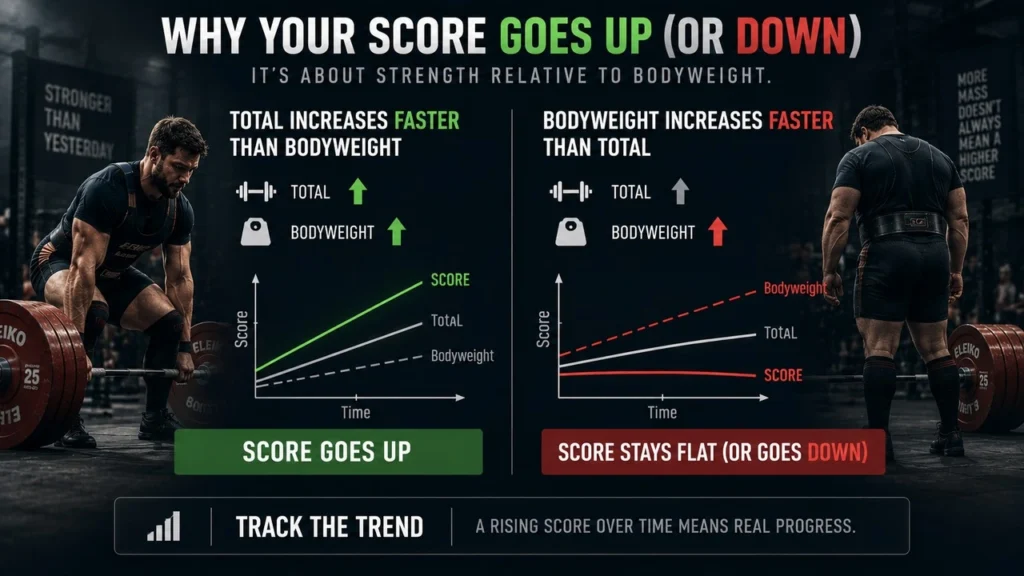
Check your score consistently at the same training bodyweight rather than at your competition weigh-in weight. Competition cuts can lower your official bodyweight and inflate your score temporarily without reflecting a real change in relative strength.
Frequently asked questions
What is a good DOTS score?
There is no official standard. Scores around 300 are broadly associated with a local competitive level, around 400 with advanced, and above 500 with elite in raw drug-tested lifting. These are community patterns, not official thresholds.
What is a good Wilks score?
Similar patterns apply. Scores around 300 suggest a local competitive level, around 400 advanced, and above 500 broadly elite. Wilks and DOTS will not always produce the same number for the same lifter.
Are DOTS and Wilks benchmarks the same?
Roughly, yes. Both systems produce scores in a similar range for most lifters. But the formulas are different, and the numbers can diverge, particularly at lighter and heavier body weights. Always compare within the same scoring system.
Do men and women use the same benchmark ranges?
Both DOTS and Wilks use separate coefficient sets for male and female lifters. The same reference ranges serve as a general guide for both, though how well the scores compare across sexes depends on the formula and bodyweight range.
Does gaining muscle raise my score?
Only if your total increases faster than your bodyweight. Gaining mass without a proportional strength increase will lower or flatten your score even if your absolute lifts improve slightly.
Track the number that matters
A single score tells you where you are. A score that rises consistently tells you whether your training is working.
Calculate your DOTS and Wilks scores together at dotscalculator.com.