Wilks Score in Powerlifting: What It Is, How It Works, and Who Still Uses It
Adrian Callen
Last updated
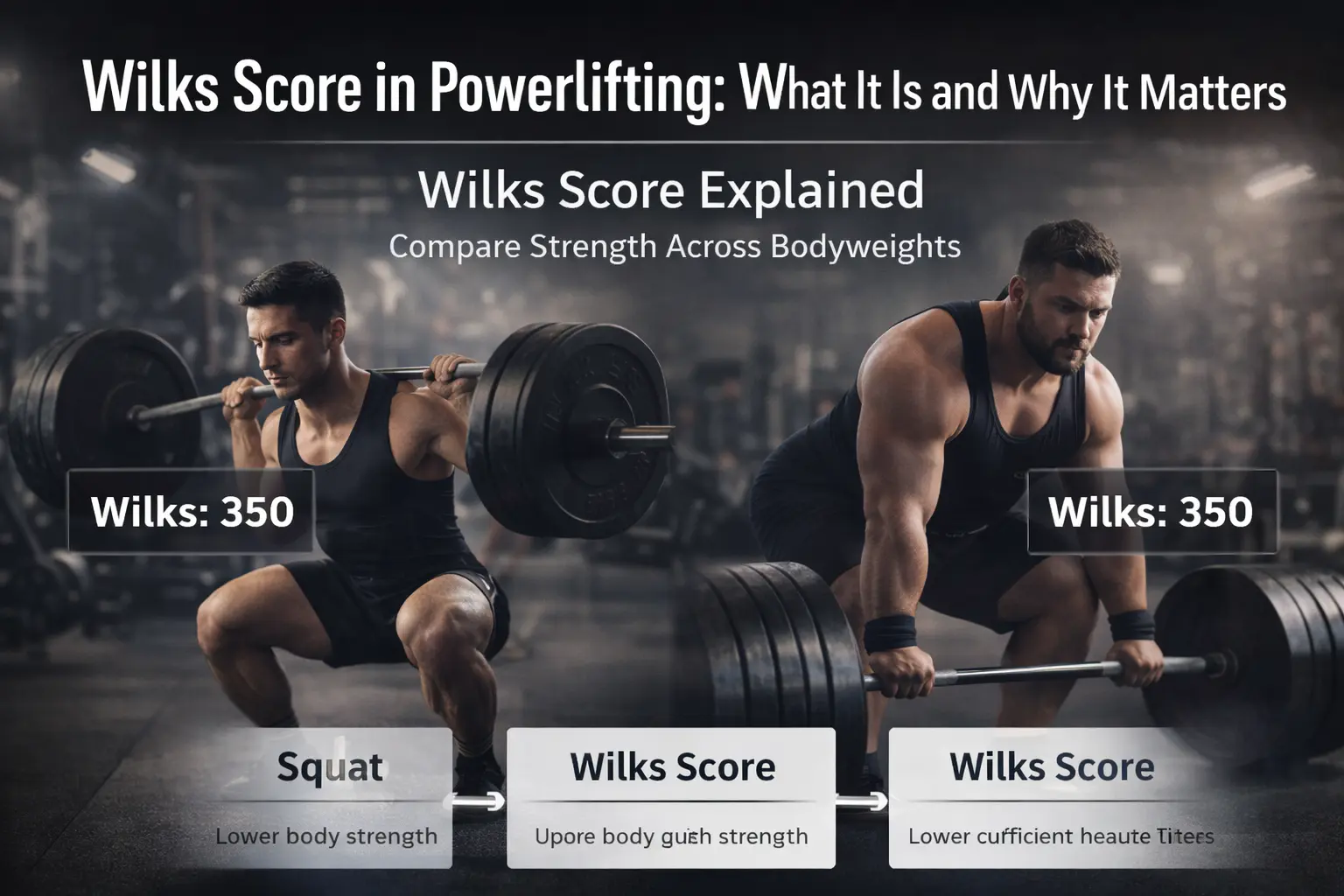
The Wilks score was powerlifting’s standard method for comparing lifters across weight classes for over two decades. It is no longer universal, but it is still in use and still worth understanding.
What is a Wilks score?
A Wilks score is a bodyweight-adjusted number that allows powerlifters of different sizes to be compared on relative strength. Robert Wilks, CEO of Powerlifting Australia, developed the formula using IPF-equipped competition data from roughly 1987 to 1994. It was validated against world record holders at the 1996 and 1997 IPF World Championships. From the mid-1990s through the late 2010s, it was the dominant scoring system across the IPF and many affiliated national federations.
How is the Wilks score calculated?
The formula multiplies your powerlifting total by a coefficient based on your bodyweight:
Wilks = Total (kg) × Coefficient (BW)
The coefficient comes from a fifth-degree polynomial with six terms. Robert Wilks used separate coefficient sets for male and female lifters. The Wilks formula and DOTS use different mathematical structures and were calibrated on different datasets, so scores from the two systems are not directly interchangeable.
Your total is the sum of your best squat, bench press, and deadlift, each requiring a valid completed attempt.
What do Wilks scores mean?
A higher Wilks score means stronger performance relative to bodyweight. The ranges below are rough community reference points based on patterns observed across competitive results. They are not official federation standards and will vary by sex, weight class, equipment, and federation.
| Level | Wilks (approximate) |
| Recreational | Under 300 |
| Competitive local | 300 – 400 |
| Advanced | 400 – 500 |
| Elite | 500+ |
Equipped lifting produces higher totals, so equipped Wilks scores tend to run higher than raw scores at the same bodyweight. Always compare scores within the same division.
Is the Wilks score still used today?
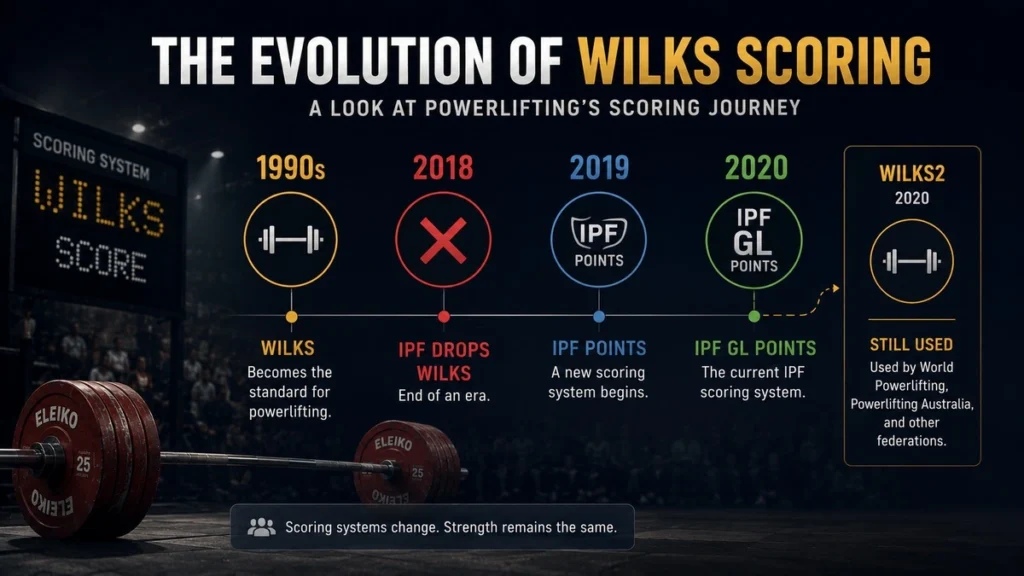
Yes, though its role has narrowed. The IPF dropped Wilks at the end of 2018, moving to its own IPF Points system in 2019 and then to IPF GL Points in 2020. Several non-IPF federations moved to DOTS around the same time.
World Powerlifting and Powerlifting Australia still use Wilks or Wilks2 officially. Smaller federations like RPS, SPF, and APF have continued using it as well. Many lifters track it personally because decades of competitive results exist under the Wilks formula, making historical comparisons easier.
Check your federation’s rulebook to confirm which system applies before comparing scores with other lifters.
How does Wilks differ from DOTS?
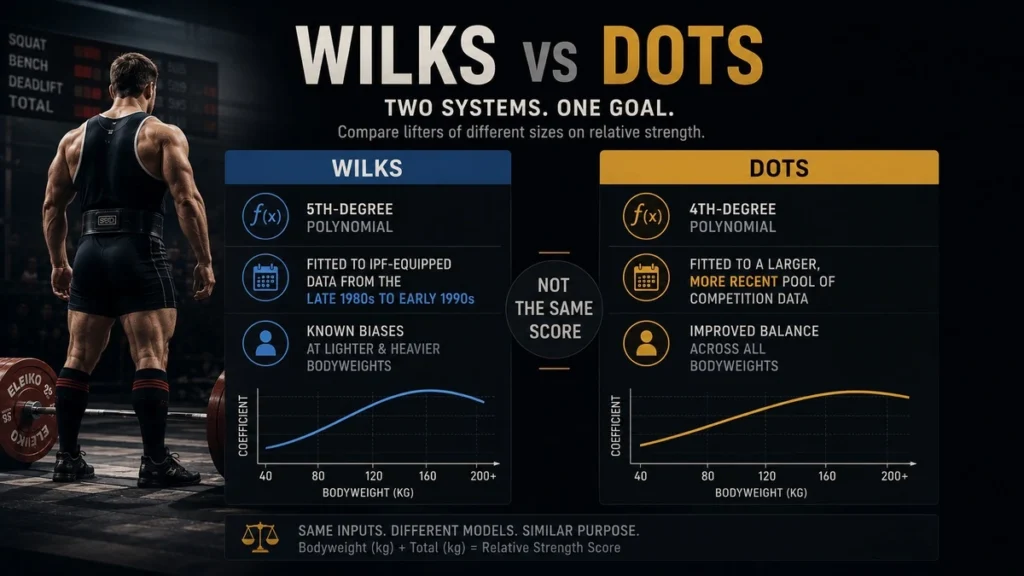
Both are relative-strength scoring systems that use bodyweight and total as inputs, but they are built on different formulas and datasets. Wilks uses a fifth-degree polynomial fitted to IPF-equipped data from the late 1980s and early 1990s. DOTS uses a fourth-degree polynomial built on a larger, more recent pool of competition results.
Research has identified biases in the original Wilks formula at lighter and heavier bodyweights, which was a key reason federations began adopting alternatives. Wilks and DOTS scores for the same lifter are often close but not identical. A full comparison of Wilks, DOTS, and IPF GL shows where and why the numbers diverge.
What is Wilks2?
In March 2020, Robert Wilks published an updated version of his formula, commonly called Wilks2 or Wilks 2020. The polynomial structure stays the same, but the coefficients were recalibrated to reduce the known bodyweight biases in the original. Powerlifting Australia uses Wilks2 as their current official formula. The score difference from the original is small in the middle weight classes but more noticeable at the extremes.
Frequently asked questions
What is a Wilks score in powerlifting?
A Wilks score shows your strength compared to your body weight. It combines your squat, bench press, and deadlift total with a bodyweight coefficient. This gives you one number that can be compared across all weight classes
What is a good Wilks score?
There is no official threshold. Scores under 300 are generally recreational, 300 to 400 is competitive at the local level, 400 to 500 is advanced, and above 500 is broadly considered elite. These are community patterns, not federation standards.
Which federations still use Wilks?
World Powerlifting, Powerlifting Australia, RPS, SPF, and APF still use Wilks or Wilks2 officially. The IPF switched to IPF GL in 2020. USPA moved to DOTS around the same time.
Is Wilks the same as DOTS?
No. Both measure relative strength using bodyweight and total but use different formulas fitted to different datasets. The scores are not directly interchangeable.
Does Wilks still matter if my federation uses DOTS?
It can, especially for comparing historical results or tracking your own progress over time. But for meet day, use whatever scoring system your federation officially applies. That is the number that counts on the results sheet.
Calculate your Wilks score
If your federation uses Wilks, it is the number that counts on meet day. Run your total and bodyweight through the Wilks calculator to see your score alongside DOTS from the same inputs.