How the DOTS Formula Works: Inputs, Coefficients, and a Verified Calculation
Adrian Callen
Last updated
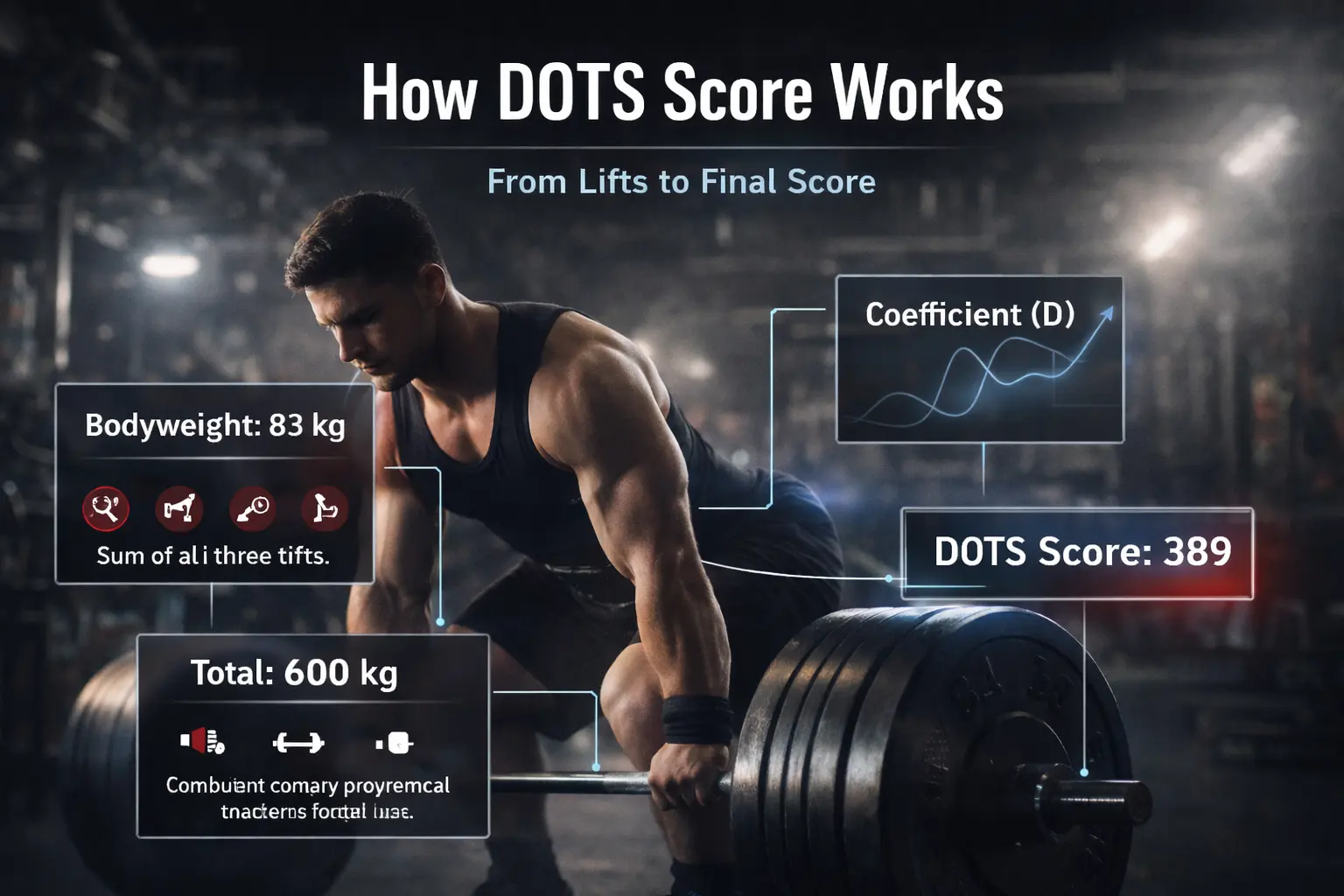
Once you know what a DOTS score represents, the next question is usually how the number actually gets produced.
This article covers the formula, the polynomial denominator, the coefficient, and what happens when any input changes.
What inputs does the DOTS formula require?
Three inputs only: bodyweight in kilograms, powerlifting total in kilograms, and sex. Nothing else enters the calculation. Age, height, and equipment type play no role in the formula itself.
Your total is the sum of your best successful squat, bench press, and deadlift. All three need a valid completed attempt. Miss one and there is no total, which means no score.
What does the formula look like?
The calculation follows this structure:
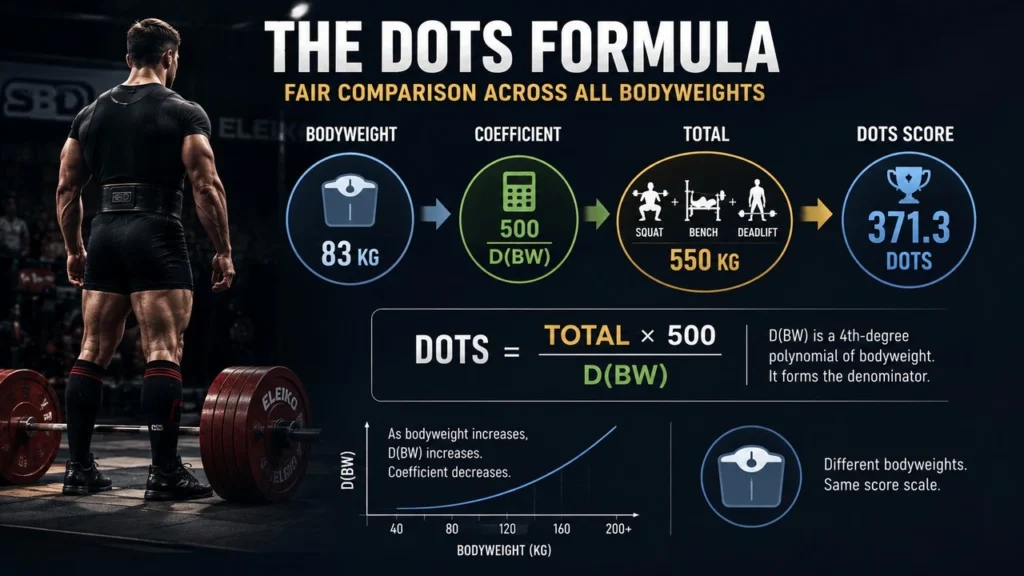
DOTS = Total (kg) × 500 ÷ D(BW)
D is a fourth-degree polynomial of your bodyweight. It produces the denominator. Dividing 500 by D gives the coefficient, which is multiplied by your total to produce the final score.
The denominator uses this structure:
D = a×BW⁴ + b×BW³ + c×BW² + d×BW + e
The published coefficients differ by sex:
| Coefficient | Male | Female |
| a | −0.0000010930 | −0.0000010706 |
| b | +0.0007391293 | +0.0005158568 |
| c | −0.1918759221 | −0.1126655495 |
| d | +24.0900756 | +13.6175032 |
| e | −307.75076 | −57.96288 |
Both sexes produce scores on the same final scale.
Why does bodyweight affect the denominator?
At higher bodyweights, D increases, and the coefficient shrinks. At lower weights, D is smaller, and the coefficient grows. This is the mechanism that allows a lighter lifter with a smaller total to score equally with a heavier lifter who totals more in absolute terms.
A linear formula would over-reward or under-reward lifters at different bodyweights. The polynomial was fitted to real competition data to model how the relationship between mass and strength actually behaves across the competitive range.
What does a verified calculation look like?
Take a male lifter at 83 kg with a 550 kg total.
Step 1—Calculate D:
- a × BW⁴ = −0.0000010930 × 47,458,321 = −51.87
- b × BW³ = +0.0007391293 × 571,787 = +422.62
- c × BW² = −0.1918759221 × 6,889 = −1,321.83
- d × BW = +24.0900756 × 83 = +1,999.48
- e = −307.75
D = 740.64
Step 2—Calculate DOTS:
500 ÷ 740.64 = 0.6751
550 × 0.6751 = 371.30 DOTS
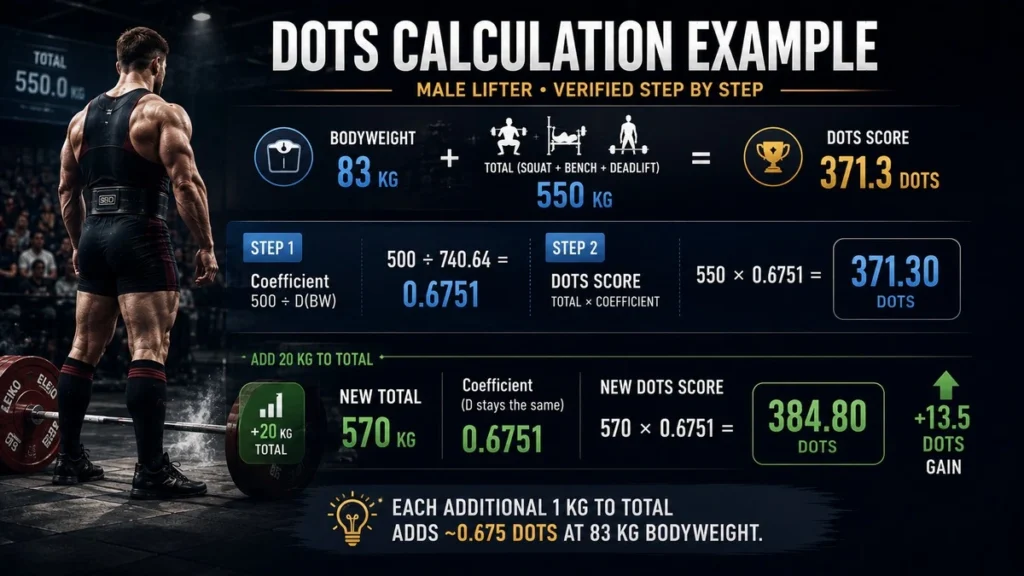
Now add 20 kg to the total, reaching 570 kg. D stays the same. The new score is 570 × 0.6751 = 384.80 DOTS—a gain of 13.5 points. Each additional kilogram of total adds roughly 0.675 points at this bodyweight.
What bodyweight range does the formula cover?
The formula is calibrated for male lifters between 40 and 210 kg and female lifters between 40 and 150 kg. Outside those ranges, the polynomial extends beyond its source data, and scores become less reliable.
How does the formula handle pounds?
The DOTS formula runs on kilograms only. Divide any pound value by 2.20462 before entering it. The dots score calculator handles this conversion automatically when you switch the unit setting.
Does equipment change the calculation?
The polynomial and coefficient are the same for raw and equipped lifters. Equipped gear allows larger totals, so equipped scores tend to run higher at the same bodyweight. Comparing equipped and raw DOTS scores directly does not give a meaningful result.
Frequently asked questions
What three things does the DOTS formula need?
Bodyweight in kilograms, powerlifting total in kilograms, and sex. Age, height, and equipment type are not part of the formula.
Why do men and women use different coefficients?
The relationship between bodyweight and strength differs between sexes. Separate coefficients model each curve accurately while keeping both on the same score scale.
Does the formula change for equipped lifting?
No. The same polynomial applies regardless of equipment. Equipped totals are typically higher, which produces higher scores, not a different formula.
Can I calculate DOTS using pounds?
No. Convert to kilograms first by dividing pounds by 2.20462. Most online calculators handle this automatically.
Run the numbers
The calculation is straightforward but precise enough that manual errors are easy to make. Enter your bodyweight, squat, bench, and deadlift into the DOTS calculator and get your result instantly without any manual conversion.