How to Find and Compare Your DOTS and Wilks Scores on OpenPowerlifting
Adrian Callen
Last updated
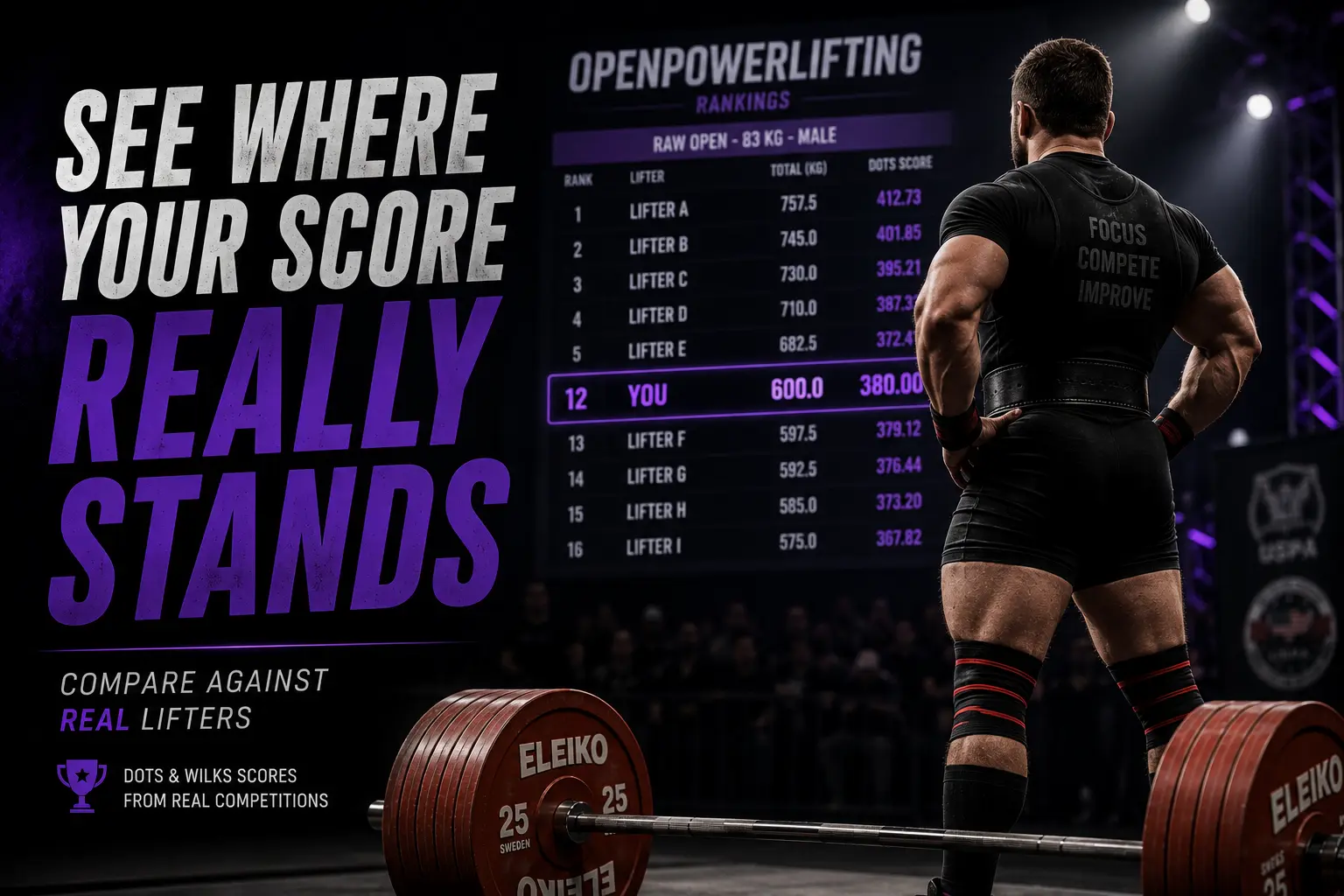
You calculated your score. Now you want to know where it actually sits in the real world.
OpenPowerlifting is the largest public database for powerlifting results. It includes meet results, totals, and scores from competitions. Everything is searchable and free to access.
What is OpenPowerlifting?
OpenPowerlifting is a non-profit project. It collects and publishes powerlifting competition data from federations around the world. It covers results from USPA, USAPL, IPF, WRPF, and dozens of other organizations going back decades.
Why it matters for score comparison
Every result in the database includes a DOTS score with the raw total. Wilks scores are also available for older results. This makes the database one of the best tools for comparing your score with real competition data at every level.
How do you find your score on OpenPowerlifting?
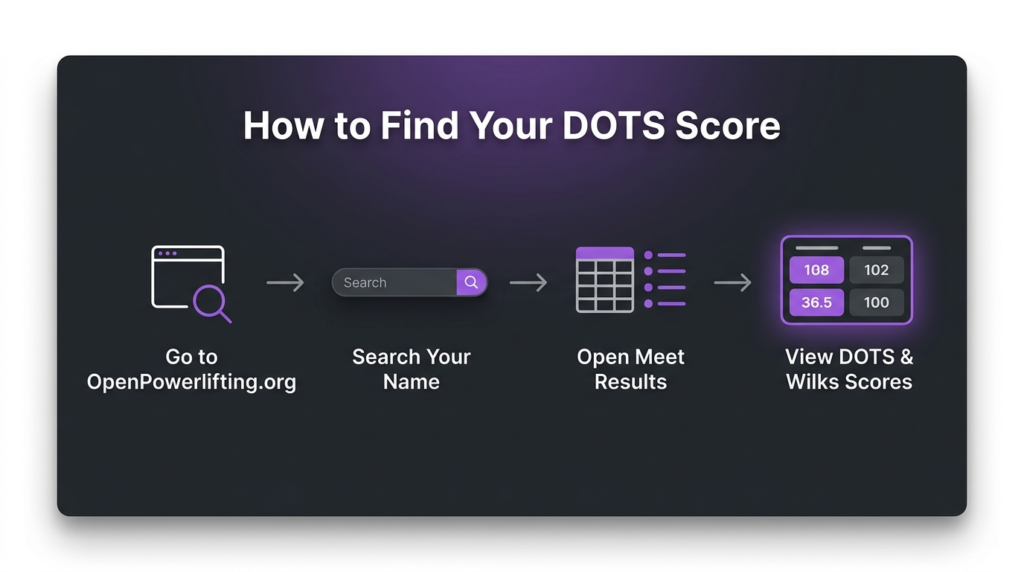
Go to openpowerlifting.org and use the search bar at the top of the rankings page. Type your full name as it appears on your competition entry. Your meet results show your total, body weight, and DOTS score. Each competition you enter is listed separately.
What if you have never competed?
Non-competitive lifters will not appear in the database. OpenPowerlifting only records officially sanctioned meet results. If you have never competed, you can still compare your strength. Calculate your DOTS or Wilks score using the calculator. Then manually compare your score with the rankings on the site.
How do you filter rankings by scoring system?
The OpenPowerlifting rankings page has a dropdown menu at the top. You can filter by federation, equipment type, weight class, sex, and age division. The default ranking column shows DOTS scores for most raw divisions.
Switching between DOTS and Wilks display
The database calculates both DOTS and Wilks for most results. The column displayed by default depends on the federation selected. USPA results default to DOTS. Historical results from pre-2020 meets often show Wilks as the primary score. You can sort by either column to reorder the rankings.
How do you compare your score to other lifters?
Filter the rankings to match your own division. Select your federation, equipment category, sex, and weight class. The ranked list shows every lifter in that division ordered by score.
Finding your percentile
Scroll through the filtered results and look for your score. This shows where you would rank in that division. For example, a 380 DOTS score in the raw open 83 kg male class places you within a certain percentage of lifters in that category. This gives more real competition context than a general benchmark table.
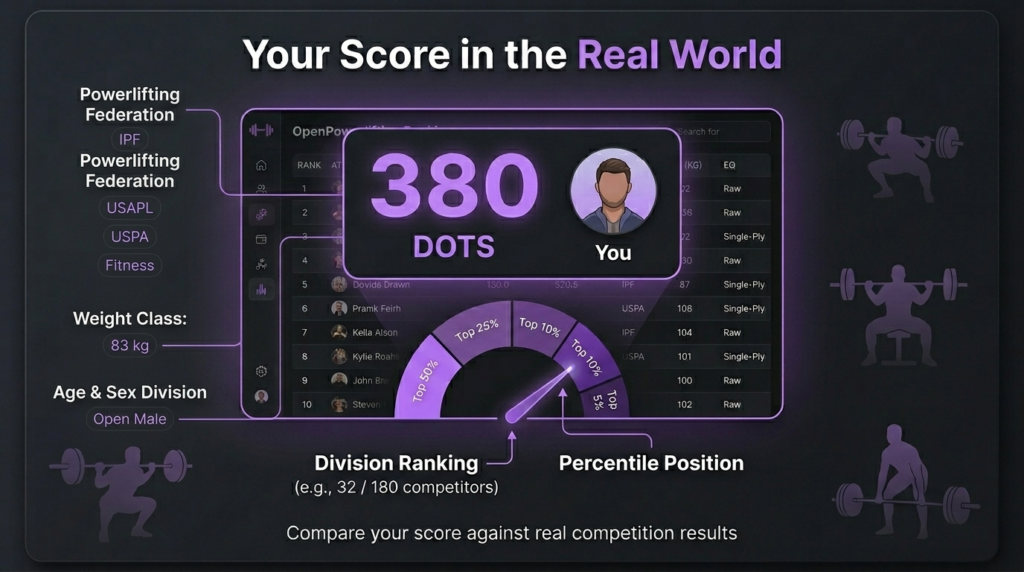
Benchmark ranges give a useful general guide. But OpenPowerlifting shows where you stand against real lifters in your division.
What does the DOTS column show on OpenPowerlifting?
The DOTS column shows the calculated DOTS score for each competition result. It uses the standard DOTS formula applied to the competition total and bodyweight recorded at that meet. The score reflects competition-day performance, not training maxes.
Why your score may differ from your calculator result
Your OpenPowerlifting DOTS score uses your official competition bodyweight and total. Your calculator result uses whatever numbers you enter. Your training body weight may be different from your competition weigh-in weight. Because of that, the two scores may not match exactly.
This is also why cutting weight can change your score on meet day. The result may be different from your normal training baseline. Competition weigh-ins produce your official score. Training calculations are estimates.
How do you track your progress over time on OpenPowerlifting?
Search your name and look at your full results history. Each meet appears as a separate row with its date, total, bodyweight, and calculated score. You can see exactly how your DOTS or Wilks score moved across every competition you have entered.
What consistent progress looks like
A lifter competing three times per year over three years should show a rising score trend across most of those results. Flat or declining scores across multiple meets indicate that total growth is not keeping pace with bodyweight changes. That is exactly the kind of insight that changes how you approach your next training block.
Using your OpenPowerlifting history together with score-based goals gives you a clear plan. You get both the data and the direction needed to make each training cycle more focused.
Can you compare results across different federations on OpenPowerlifting?
Yes, but carefully. DOTS scores are comparable across federations that use the same formula. A 400 DOTS from a USPA meet and a 400 DOTS from a WRPF meet represent the same level of performance.
Where cross-federation comparison breaks down
IPF results use IPF GL Points, not DOTS. Comparing your DOTS score to an IPF GL score is not valid. The two formulas use different scales entirely. OpenPowerlifting displays both, but they sit in separate columns for exactly this reason.
Lifters moving between federations should check which scoring system each one uses. This is important before comparing scores across different federations.
Is OpenPowerlifting data accurate?
OpenPowerlifting collects data from official meet results and federation records. Mistakes can happen sometimes. But they are uncommon and can usually be fixed through the public correction system. The database is trusted by federations, coaches, and analysts. It is considered one of the most reliable public sources for powerlifting data.
How to report a missing or incorrect result
If your result is missing or has an error, OpenPowerlifting allows corrections to be submitted through its GitHub repository. Meet directors can also submit results directly. Most corrections are updated within a few weeks.
Frequently asked questions
Does OpenPowerlifting show DOTS scores?
Yes. OpenPowerlifting calculates and displays DOTS scores for most competition results across all major raw federations.
Can gym lifters use OpenPowerlifting for score comparison?
Yes. Search filtered rankings by division and weight class. Compare your calculated score from the powerlifting calculator against real competition results in your category.
Why does my OpenPowerlifting score differ from my calculator score?
OpenPowerlifting uses your official competition bodyweight and total. Your calculator uses whatever numbers you enter. Different bodyweight inputs produce different scores.
Does OpenPowerlifting show Wilks scores?
Yes. Historical results include Wilks scores. Both DOTS and Wilks columns are available for most results depending on the federation and meet date.
Is OpenPowerlifting free to use?
Yes. OpenPowerlifting is a free, non-profit public database. No account or subscription is required to search for results or view rankings.
Your Score in the Real World
A calculated score only gives you a number. OpenPowerlifting shows what that number actually means compared to real lifters in your division. Use both together. First, calculate your score using the DOTS and Wilks calculator on this page. Then check OpenPowerlifting. It shows how your score compares with real competitive lifters around the world.