What Happens to Your DOTS or Wilks Score When You Miss a Lift or Factor in Age
Adrian Callen
Last updated

You bombed out on squats. Or you only train two of the three lifts.
Does your DOTS or Wilks score still work? And does getting older change the number on its own?
These are real questions with specific answers that affect how you track and use your score.
Does age affect your base DOTS or Wilks score?
No. The base DOTS and Wilks formulas only use two inputs: your bodyweight and your powerlifting total. Age plays no role in either calculation. A 22-year-old and a 55-year-old with identical totals and bodyweights get identical base scores.
When age does change your score
Age only enters the picture in master competitions. Federations apply a separate McCulloch coefficient on top of your base score for masters divisions. That multiplier increases with age. It exists to make master lifters comparable to each other, not to open division athletes.
If you want to understand how McCulloch coefficients adjust masters scores, the full breakdown covers exactly how those multipliers are calculated and applied at the competition level.
Does a missing lift affect your DOTS or Wilks score?
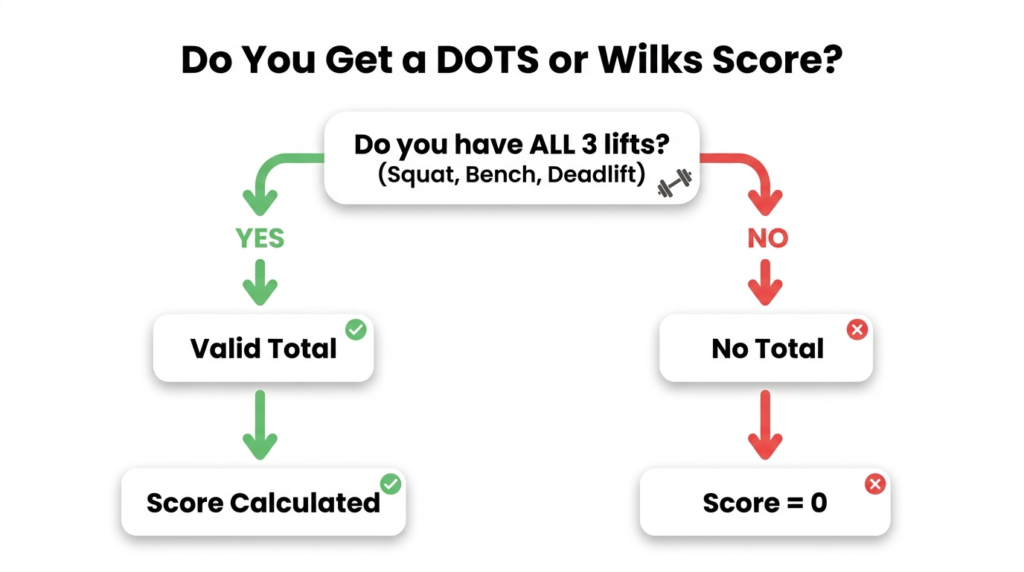
Yes, completely. Both formulas require a valid squat, bench press, and deadlift to produce a score. All three lifts combine to create your powerlifting total. No total means no score.
What counts as a missing lift
A missed lift in this context means any situation where you do not have a valid result for one of the three competition movements. That includes a bomb-out on all three attempts, a disqualified lift with no valid alternative, or simply not training one of the movements at all.
What happens if you bomb out at a meet?
Your score drops to zero for that meet. Bombing out means failing all three attempts on a single lift. Without a valid squat, bench press, or deadlift total, the formula has nothing to calculate.
No partial scores exist
Neither DOTS nor Wilks produces partial scores. A lifter who bombs a squat but posts a huge bench and deadlift gets no score at all. The formula needs all three numbers. This is one reason attempt selection matters so much at the competition level. The Best Lifter award system depends entirely on valid totals. A bomb-out removes you from best-lifter contention regardless of how strong your other two lifts were.
Can you calculate a score with only two lifts?
Technically, yes, but it is not meaningful for competition comparison. Some calculators will produce a number if you enter only two lifts. That number cannot be fairly compared to full power scores.
Push-pull and bench-only scores
Push-pull meets the cover bench press and deadlift only. Bench-only meets cover a single lift. Both formats produce totals and scores, but on a completely different scale from full-power results. A 350 DOTS from a push-pull meet is not the same as a 350 DOTS from a full power meet. Never compare single-lift or two-lift scores to full power scores directly. The scoring formula calculations are built around three-lift totals. Using fewer lifts breaks the comparison entirely.
What if one of your lifts is very weak?
Your score takes a hit, but you still get a number. A lifter with a strong squat and deadlift but a weak bench press gets a valid score. It would be lower than their potential if the bench were stronger.
How a weak lift drags your score down
Each lift contributes equally to your total. A 20 kg gap between your actual bench and your potential bench costs you exactly 20 kg in total. At an 83 kg bodyweight, that gap alone costs roughly 13 DOTS points.
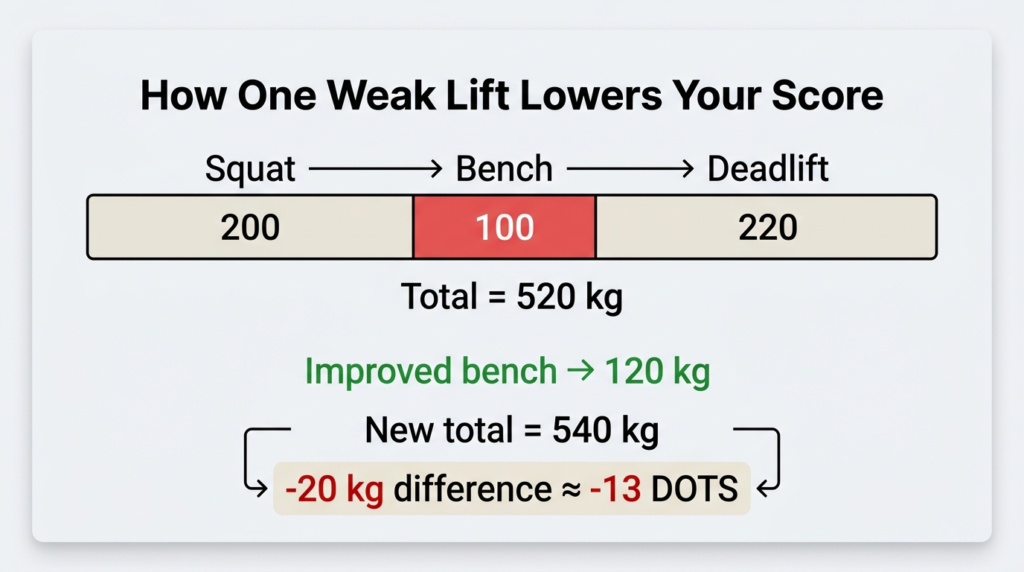
This is why addressing your weakest lift first produces the fastest score gains. One lagging lift holds back your entire total more than evenly distributed weakness across all three movements.
Does missing training on one lift hurt your score long-term?
Yes. Lifters who consistently neglect one of the three movements fall behind their potential score over time. The total grows slower than it should. The coefficient stays the same. The score stagnates.
The bench press is the most commonly neglected lift
Many powerlifters prioritize squat and deadlift in their programming. The bench press gets one session per week, while the other two get two or three. That imbalance shows up directly in the score over a 12 to 24-month training window. A balanced approach to all three lifts produces the most consistent score growth. Check where each lift sits as a percentage of your total using the powerlifting calculator here.
Frequently asked questions
Does age lower your DOTS score automatically?
No. Base DOTS only uses bodyweight and totals. Age has no effect on the formula itself.
What happens to your score if you bomb out?
Your score becomes zero. No valid total means no DOTS or Wilks score for that competition.
Can you get a DOTS score with only two lifts?
Technically yes, but it is not comparable to full power scores. Two-lift results use a different competitive context entirely.
Does a weak bench press affect your DOTS score?
Yes. Every kilogram missing from your bench press reduces your total and lowers your score directly.
Do master lifters get a higher base DOTS score because of age?
No. Base DOTS is identical regardless of age. Age adjustments are applied separately using the McCulloch coefficient in masters divisions only.
The Score Needs All Three
Your DOTS or Wilks score is only as strong as your weakest lift. Miss one entirely and the number disappears. Neglect one in training and the number stagnates.
All three lifts matter equally in the formula. Train them that way.