How DOTS and Wilks Scores Work for Female Powerlifters
Adrian Callen
Last updated
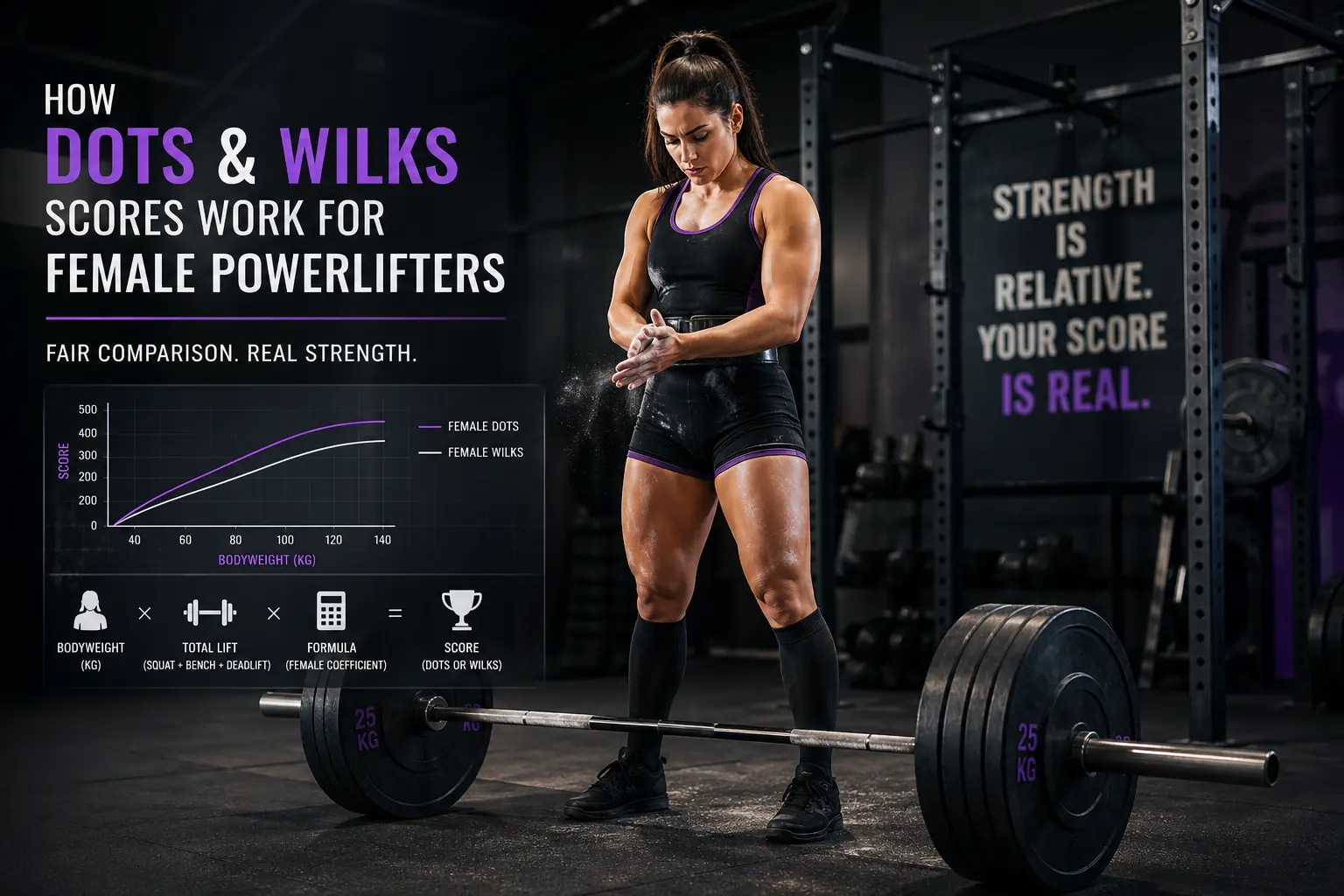
You calculated your score and compared it to numbers online. Most of those numbers are for male lifters.
Female powerlifters use the same scoring systems. But the formulas behind them are not identical.
Do DOTS and Wilks use different formulas for women?
Yes. Both DOTS and Wilks apply separate polynomial coefficients for female lifters. The constants in those equations differ from the male version. This reflects the real difference in how strength scales with bodyweight across sexes.
Why do separate coefficients exist
Male and female strength curves follow different patterns across bodyweight ranges. A single universal formula would systematically over- and undervalue female performances. Separate coefficients are used for men and women. They adjust for biological differences. Even with this adjustment, both scores stay on the same scale.
Are female DOTS and Wilks scores comparable to male scores?
Yes. The scoring scale is the same for both. A 350 DOTS from a female lifter represents the same relative strength level as a 350 from a male lifter. Both formulas are designed to make cross-gender comparison meaningful.
What this means in practice
A female lifter with a score of 380 DOTS and a male lifter with 380 are at the same level. Their strength is equal relative to their body size. Neither score is adjusted down nor inflated. The coefficient does the work of making both numbers land on the same scale.
This is one reason DOTS is more accurate than the original Wilks. It used a much larger dataset for female lifters. The 1995 Wilks formula had far less data available.
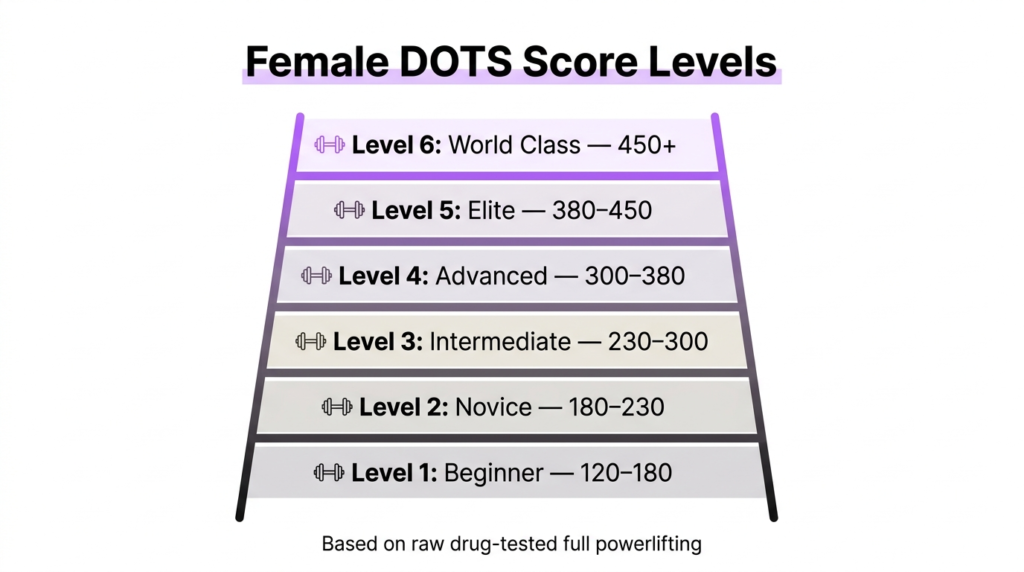
What are good DOTS score benchmarks for female lifters?
These ranges apply to raw drug-tested full power lifting for female athletes.
First competition targets for women
A female lifter entering her first local meet typically scores between 200 and 300. Scoring above 280 at your first meet is a strong start. It puts you ahead of many beginner lifters. This is especially true in raw open divisions.
What are good Wilks score benchmarks for female lifters?
Wilks produces slightly different numbers than DOTS for the same lifter. Do not compare your Wilks score directly to your DOTS score.
| Level | Wilks score |
| Beginner | 100 – 175 |
| Novice | 175 – 250 |
| Intermediate | 250 – 325 |
| Advanced | 325 – 400 |
| Elite | 400 – 475 |
| World class | 475+ |
How female Wilks scores compare historically
The original Wilks formula had a known weakness in its female coefficients. The 1995 dataset used to build the formula underrepresented female lifters significantly. Wilks2 addressed this in 2020 with recalibrated constants. Female lifters in federations using Wilks2 get a fairer score than those still using the original formula.
Does bodyweight affect female scores differently from male scores?
The coefficient curve behaves differently for female lifters at extreme bodyweights. Very light female lifters under 47 kg fall into a smaller data range. Very heavy female lifters above 100 kg also fall into a smaller data range. In these ranges, the data behind the formulas is more limited.
The DOTS formula is valid for female lifters between 40 kg and 150 kg. Outside that range, the coefficient is extrapolating beyond reliable data. Scores outside those bounds should not be used for official comparison purposes.
Middle bodyweight female lifters
Female lifters between 57 kg and 84 kg are in the most reliable range. This is where the data behind the formulas is strongest. Scores in this range are the most accurate. They give a better picture of true relative strength.
How do female lifters use their score for progress tracking?
The same way male lifters do. Check your score at the start and end of each training block. A rising score with stable bodyweight means real relative strength gains. A flat score during a bulk means the added weight is not producing proportional strength.
Female lifters often see faster score gains in the first two years of training than male lifters at the same experience level. Strength adapts quickly early in a training career regardless of sex. Taking advantage of that window with consistent progressive overload moves the score quickly.
The goal-setting approach built around 20 to 30 point increments works exactly the same for female lifters as it does for male lifters. The benchmark numbers differ. The strategy does not.
Frequently asked questions
Do women use the same DOTS formula as men?
No. DOTS uses separate polynomial coefficients for female lifters. The scoring scale is the same for both sexes.
Is a 300 DOTS score good for a female powerlifter?
Yes. A 300 DOTS score is advanced for female lifters and competitive at regional meets.
Can female and male DOTS scores be compared directly?
Yes. Both formulas are designed to be fair for men and women. The same score means the same level of strength. This is true regardless of sex.
Why is my Wilks score different from my DOTS score?
The two formulas use different equations and datasets. They produce different numbers for the same lifter and are not directly comparable to each other.
What bodyweight range gives the most accurate female DOTS score?
Female lifters between 57 kg and 84 kg sit in the most reliable part of the DOTS coefficient curve. Scores in this range are the most statistically accurate.
Your Score Is Your Standard
Female powerlifters have the same access to meaningful relative strength data as male lifters. The formulas account for the difference. The scale stays the same.
Calculate your current score using both systems. Use the powerlifting calculator to set your next target based on your result.