DOTS and Wilks Scores for Gym Lifters: Are They Worth Tracking?
Adrian Callen
Last updated April 21, 2026

You train squat, bench, and deadlift seriously. You have no plans to compete.
Most powerlifting scores are built for meet day. Federations use them to pick the best lifters and award trophies.
But a score is just math. It does not care whether you competed or trained in your garage. If your squat, bench, and deadlift numbers go in, a valid relative strength score comes out.
The real question is whether that number actually helps you train better.
Do powerlifting scores matter outside of competition?
Yes. Both scores give gym lifters something a raw total cannot. They give you a number that still makes sense when your body weight changes. Whether you are bulking, cutting, or maintaining, your score stays useful. It shows if your strength is really improving, not just your total.
The problem with tracking totals alone
A lifter who gains 8 kg during a bulk and adds 20 kg to their total looks like they are progressing. But if their score drops from 310 to 305, that tells a different story. It means their relative strength has gone down. The total went up because they got heavier, not because they got stronger relative to their size.
What does a powerlifting score tell a gym lifter?
It tells you how your strength compares to your bodyweight at any given point in time. That information is useful whether you compete or not.
A gym lifter sitting at 320 DOTS is lifting at a level that would be competitive at a local powerlifting meet. A gym lifter at 280 is training seriously above average compared to most people in a commercial gym. Those reference points give your training real context.
Comparing yourself to real standards
Benchmark ranges show what each score means. They tell you where 280, 320, or 380 stands. You can see how you compare to recreational lifters, local competitors, and national-level athletes. That context turns a number into a meaningful performance indicator.
Which score should a gym lifter track, DOTS or Wilks?
Either works for personal benchmarking. DOTS is more accurate across a wider range of bodyweights based on modern data. Wilks is more widely recognized and has decades of historical use as a strength standard.
If you have no federation affiliation, DOTS is the better default. It gives a fairer picture of relative strength across the full bodyweight spectrum. Run both through the strength calculator and pick whichever feels more useful for your tracking system.
Does it matter which formula you pick?
For personal benchmarking, no. What matters is consistency. Pick one formula and stick with it across every check-in. Switching between DOTS and Wilks breaks your tracking. The two formulas give different scores for the same lifter. So your past and current numbers would not match.
How often should a gym lifter check their score?
Every 8 to 12 weeks is a practical frequency for most gym lifters. That window aligns with a standard training block. Check your score at the start and end of each block. This gives you a clear before-and-after view. It also avoids noise from small weekly body weight changes.
Checking more frequently than once per month adds very little useful information. Strength takes time to build. A score checked every two weeks can be misleading. It often reflects normal body weight changes. It does not always show real strength progress.
What to record each time you check
Write down your score with a few key details. Include your total, your body weight, and the date. These four numbers together give a clear picture. If your score goes up while your body weight stays the same, your strength is truly improving.
Can gym lifters use their score to find weak points?
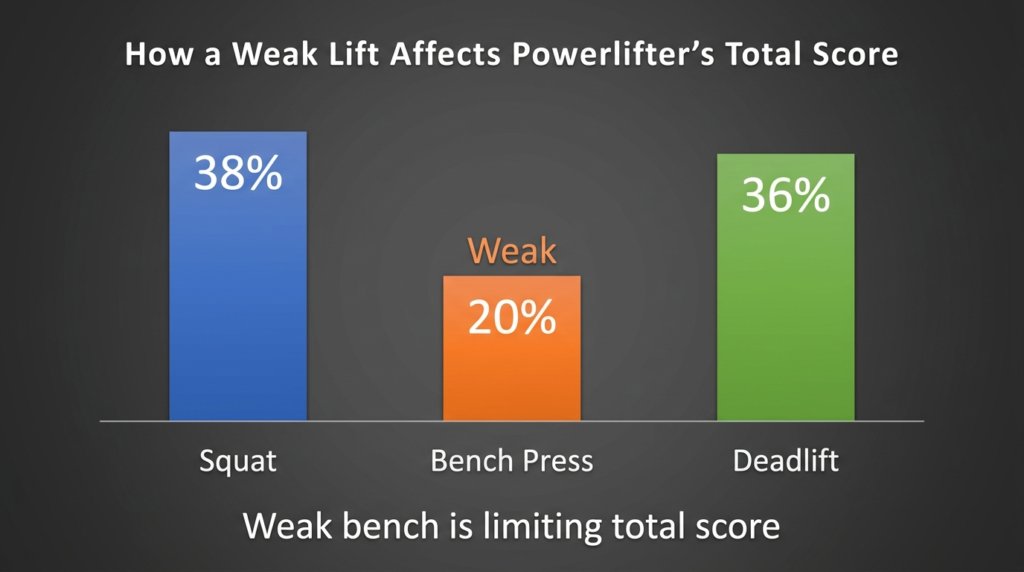
Yes. Divide each of your three lifts by your total to see their percentage contribution. A balanced raw lifter has a typical split in their total. About 38% comes from the squat. Around 26% comes from the bench press. About 36% comes from the deadlift.
If your bench sits at 20% of your total, it is the lift dragging your score down the most. Finding that imbalance helps you improve faster. Fixing your weak lift gives better results than training all lifts the same. The weak lift approach is the same strategy competitive lifters use to push their scores higher between meets.
Is a 300 score achievable for a dedicated gym lifter?
Yes. A 300 DOTS or Wilks score is within reach for most lifters who train consistently for 18 to 24 months with a structured program. It requires discipline around programming and recovery but no special genetics or elite coaching.
Crossing 300 puts you in territory where you could enter a local powerlifting meet and post a respectable result. Many gym lifters who hit that mark end up competing simply because their numbers are already there.
What happens after 300
The 300 to 370 range is where most serious gym lifters spend the majority of their training years. Moving through that range requires more than just adding volume. As progress slows, the small details matter more. Better technique becomes important. Smarter programming also makes a difference. Managing your body weight carefully starts to play a bigger role.
Does tracking your score make training more motivating?
As progress slows, the small details matter more. Better technique becomes important. Smarter programming also makes a difference. Managing your body weight carefully starts to play a bigger role.
When your squat stalls but your bench and deadlift improve, your score still moves. That continuity keeps motivation higher than tracking individual lifts in isolation.
Learning the history of these scoring systems helps you understand the numbers better. It shows what the score really represents. It also explains why it has been used for comparing lifters for so many years.
Frequently asked questions
Can gym lifters use DOTS and Wilks scores?
Yes. Any lifter can train squats, benches, and deadlifts and calculate and track either score as a personal strength benchmark.
Which is better for gym lifters, DOTS or the Wilks?
DOTS is more accurate across most bodyweights based on modern data. Either works for personal tracking as long as you use the same formula consistently.
Is a 300 DOTS score good for a gym lifter?
Yes. A 300 DOTS score puts you well above average for recreational lifters and at the entry level of competitive powerlifting.
How do I know if my relative strength is improving?
Check your score at the start and end of each training block. A rising score with stable bodyweight means your relative strength is genuinely improving.
Do I need to compete to get a meaningful score?
No. Your score is just as valid and useful as a personal benchmark, whether you compete or not.
Train With a Number That Means Something
A raw total tells you how much you lifted. Your score tells you how strong you actually are for your size.
For lifters who care about real progress, this difference matters a lot. Check your current score using the powerlifting tool on this page. Start tracking it from today.