DOTS Score in Powerlifting: What It Means and How to Read It
Adrian Callen
Last updated
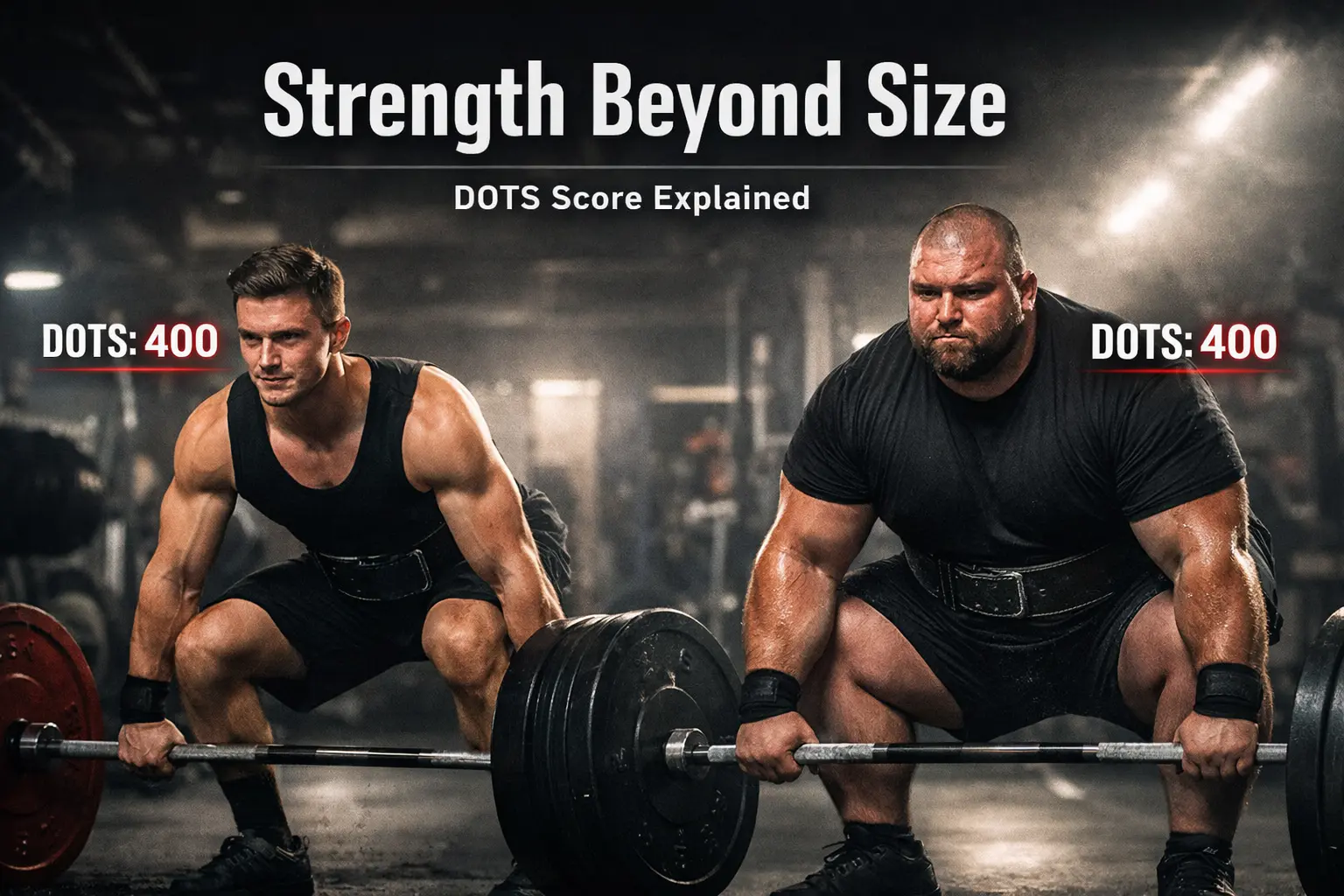
You finish a meet, and the results show a number that is not your total. That number is your DOTS score.
It is how powerlifting compares lifters of different sizes on equal terms. Here is what it means and how to use it.
What is a DOTS score?
A DOTS score is a bodyweight-adjusted number that represents your strength relative to your size. It takes your squat, bench press, and deadlift total and scales it against your bodyweight so lifters across all weight classes can be compared fairly.
DOTS stands for Dynamic Objective Team Scoring. The formula was developed by Tim Konertz, affiliated with the German Powerlifting Federation, and published in 2019. It was built to address known biases in the Wilks formula, particularly at lighter and heavier bodyweights where Wilks produced less reliable results.
What problem does DOTS solve?
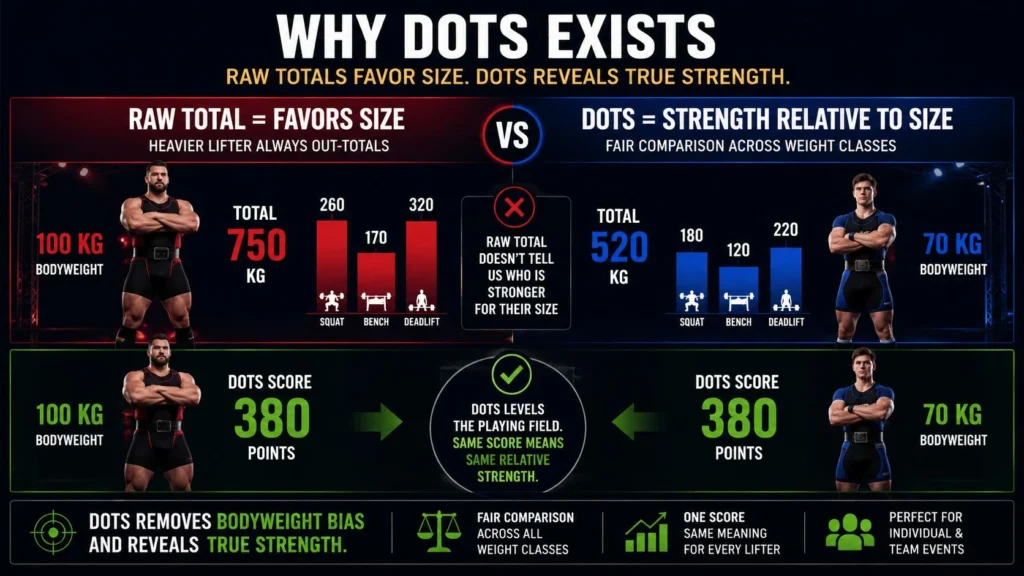
Raw totals favor heavier lifters. A 100 kg lifter will almost always out-total a 70 kg lifter in absolute terms, but that does not tell you who is stronger for their size.
DOTS removes that bias. Two lifters at very different bodyweights can score the same number, and that number means the same thing for both. A score of 380 reflects the same level of relative strength regardless of whether the lifter weighs 60 kg or 110 kg.
How is a DOTS score calculated?
The formula multiplies your total by a coefficient derived from your bodyweight:
DOTS = Total (kg) × 500 ÷ P(bodyweight)
P is a fourth-degree polynomial with separate coefficient sets for male and female lifters. The coefficient decreases as bodyweight increases, which is what allows the comparison across weight classes to work. Both sexes use the same final score scale, so a 370 from a female lifter reflects the same relative performance as a 370 from a male lifter.
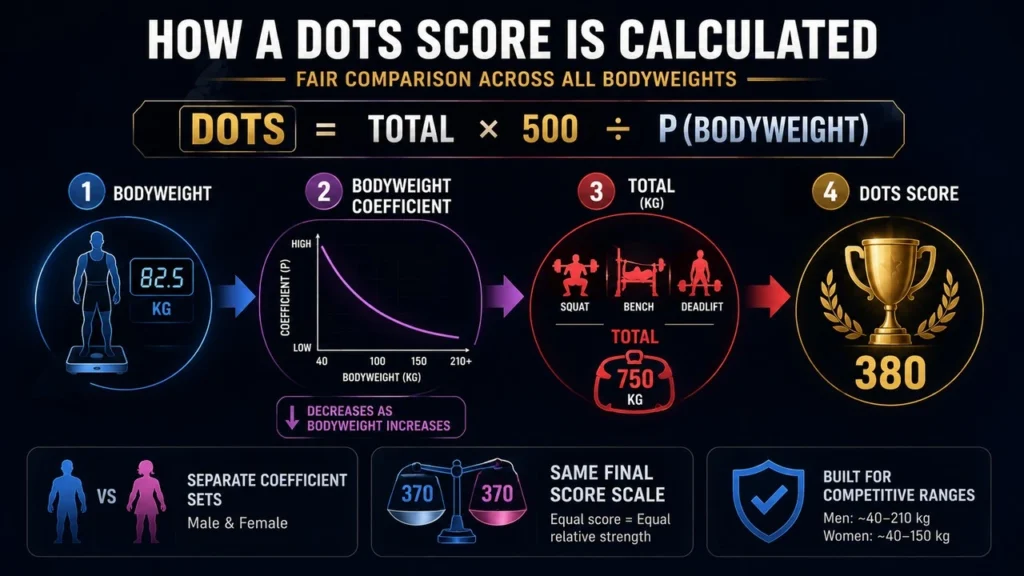
The formula is designed for competitive bodyweight ranges: roughly 40 to 210 kg for men and 40 to 150 kg for women. Results outside those ranges are less reliable because the underlying dataset thins at the extremes.
Enter your bodyweight, squat, bench, and deadlift into the DOTS calculator to get your score without running the math. A full breakdown of the formula and its coefficients is available if you want to understand the calculation in detail.
Which lifts count?
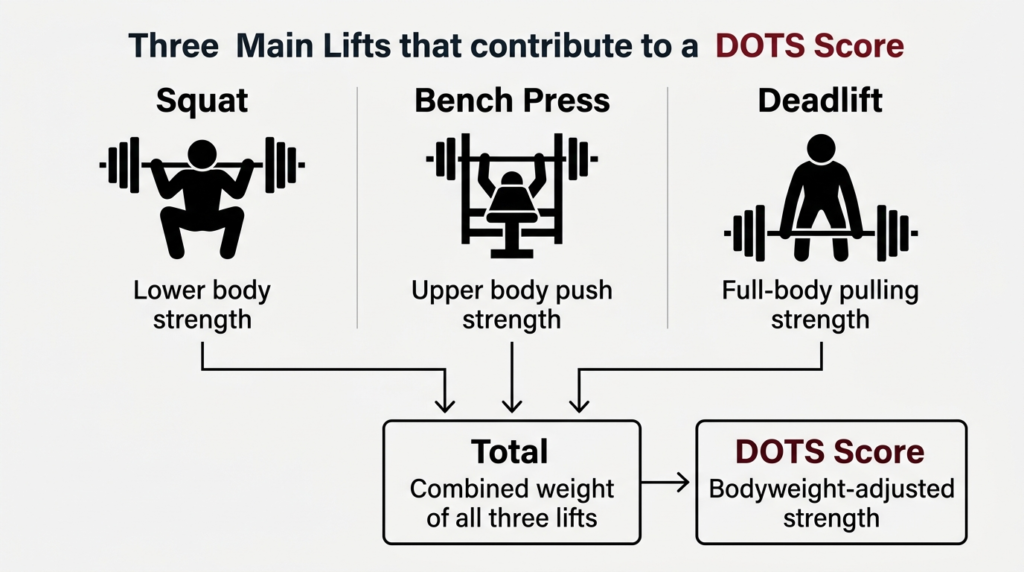
All three powerlifting lifts count: squat, bench press, and deadlift. Your best successful attempt at each is added together to form your total. That total is the only lifting input to the formula.
If you do not record a valid attempt on any of the three, you have no total and no DOTS score.
How do you read your result?
A higher score means stronger performance relative to your bodyweight. The infograph below shows informal benchmarks used widely across the powerlifting community. These are not official standards and will vary by sex, weight class, equipment division, and federation.
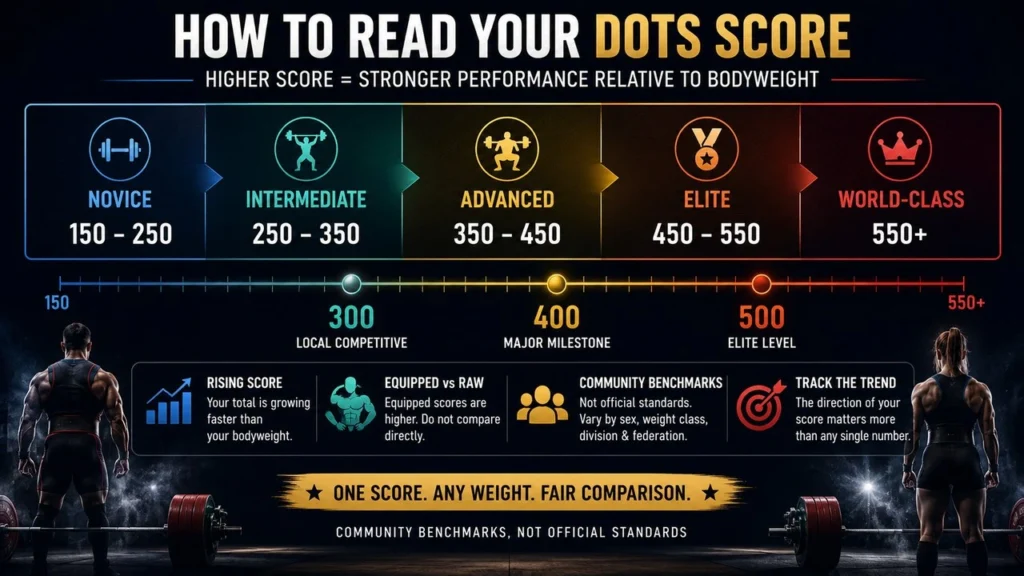
A score around 300 is generally considered competitive at the local level. Around 400 is widely treated as a meaningful milestone, the point where relative strength is clearly strong across most weight classes. Above 500 is broadly described as elite. These reflect community patterns, not federation-set thresholds.
Equipped lifting produces higher totals than raw lifting, so equipped and raw scores should not be compared directly.
The most useful way to track DOTS is over time. A rising score means your total is growing faster than your bodyweight. That direction matters more than any single number.
How does DOTS compare to Wilks and IPF GL?
All three systems adjust a powerlifting total for bodyweight. They differ in their formulas and in which federations use them.
Wilks has been in use since the mid-1990s. DOTS followed in 2019, built on more recent competition data to reduce the bodyweight-extreme biases that Wilks carried. In an evaluation the IPF published in 2020, which compared GL, DOTS, Wilks, and Wilks2 across all weight classes, DOTS ranked second overall behind the IPF’s own IPF GL formula.
DOTS and Wilks produce scores in a similar numeric range for most lifters. IPF GL uses a different mathematical structure entirely and produces much lower numbers, a 75 IPF GL score is not the same as a 75 DOTS score.
USPA and WRPF use DOTS for best lifter awards. The IPF and its affiliates, including USAPL, use IPF GL. The full comparison of all three systems explains when each one applies and which federations use which.
Frequently asked questions
What does DOTS stand for in powerlifting?
DOTS stands for Dynamic Objective Team Scoring. The name reflects its origin in team-based German powerlifting competitions before it was adopted more widely.
What is a good DOTS score?
There is no universal standard. Scores around 300 are competitive at the local level, around 400 are considered advanced, and 500 or above is broadly described as elite in raw drug-tested lifting. These are community benchmarks, not official thresholds.
Does bodyweight affect my DOTS score?
Yes. The formula applies a bodyweight coefficient. Gaining mass without increasing your total will lower your score. Keeping your total the same while losing bodyweight will raise it.
Do I need all three lifts to get a score?
Yes. DOTS requires a valid squat, bench press, and deadlift. Without all three, there is no complete total and no valid score.
Does DOTS work the same for men and women?
Yes. The formula uses separate coefficients for each sex but produces scores on the same scale. Equal scores represent equal relative strength regardless of sex.
Track the trend
Your DOTS score gives you a bodyweight-adjusted view of your strength that a raw total cannot. One number tells you where you are. A rising number across training cycles tells you whether your training is working.