Are DOTS and Wilks Scores Accurate? What the Data Actually Shows
Adrian Callen
Last updated April 15, 2026

Your score looks clean and objective. But is the formula behind it actually fair?
Every powerlifting scoring system has limitations. Some are small. Some affect entire weight classes. Knowing where each formula falls short helps you interpret your numbers honestly.
How accurate are DOTS and Wilks scores?
Both DOTS and Wilks produce reasonable relative strength estimates for most lifters. Neither is perfectly accurate across every bodyweight, sex, and division combination. The differences are most pronounced at extreme bodyweights and in equipped divisions.
The quick answer
DOTS is more consistent across all body weights than the original Wilks. Neither formula accounts for height, limb length, or body composition. Both are mathematical approximations, not perfect measures of true strength.
What did the 2020 IPF study reveal?
In March 2020, the International Powerlifting Federation reviewed several scoring formulas. They tested two main things. How fair was each formula across different weight classes? And how well it ranked lifters by real strength.
The results were clear. IPF GL Points ranked first. DOTS came second. Wilks2 came third. The original Wilks formula showed the lowest performance in several areas.
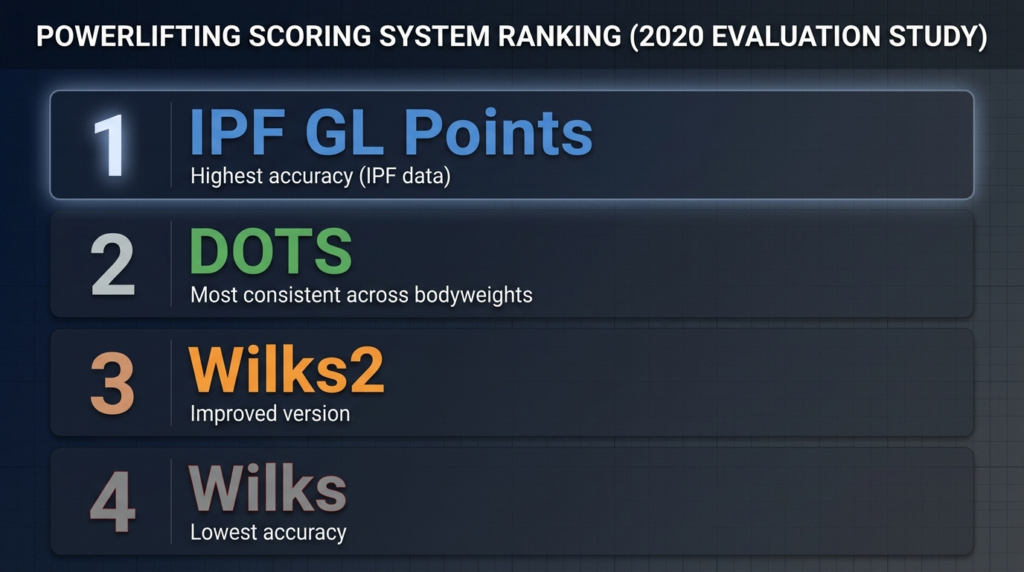
What the study measured
The evaluation used the coefficient of variation to test scoring consistency. Lower variation means the formula treats equivalent efforts more equally across weight classes. DOTS showed lower variation than the original Wilks in nearly every category tested. That gap was largest at the lightest and heaviest bodyweights.
Where does the original Wilks formula fall short?
The original Wilks formula was built on 1995 competition data. That dataset underrepresented female lifters and lifters at extreme bodyweights. The resulting polynomial curve produced a systematic scoring advantage for middleweight male lifters.
A 93 kg male lifter could score higher than a 59 kg lifter. This can happen even when both have the same level of effort. The reason is the way the formula is set up. It favors certain body weights. So, the difference comes from the formula, not actual strength.
The bias at extreme bodyweights
The original Wilks formula had some clear issues. It gave too much credit to very heavy male lifters in some cases. It also gave too little credit to very light lifters in others. Female super-heavyweight lifters also experienced the effects. Many people noticed these problems for years. Coaches and analysts pointed them out during the 2000s and 2010s. This is why the International Powerlifting Federation later decided to review the formula.
Understanding why federations moved away from Wilks helps give context. It shows why these accuracy issues were serious enough to change the sport.
Is DOTS more accurate than Wilks?
Yes, in most cases. DOTS was created to fix the problems in the Wilks formula. It uses more recent and larger data. This makes the scoring more balanced across different body weights. For example, a 59 kg lifter and a 120 kg lifter with the same level of effort will get more similar scores under DOTS. Under the original Wilks, the difference would be bigger.
The improvement is most significant at body weights below 60 kg and above 110 kg. For lifters in the 74 kg to 93 kg range, the difference between DOTS and Wilks scores is smaller but still present.
Where DOTS still has limits
DOTS performs well within its validated bodyweight range. For male lifters, that range is 40 kg to 210 kg. For female lifters, it is 40 kg to 150 kg. Outside those bounds, the formula is extrapolating beyond its dataset. Scores produced outside those ranges should not be used for official comparison.
What do neither DOTS nor Wilks account for?
Both formulas ignore several physical factors that genuinely affect lifting performance.
Height is the most discussed limitation. Two lifters at 83 kg with heights of 165 cm and 195 cm have very different mechanical advantages on the squat and deadlift. The taller lifter has a longer range of motion on every lift. Neither DOTS nor Wilks adjusts for this at all.
Limb length also plays a role. Shorter arms can help in the bench press. Longer arms can help in the deadlift. These advantages are not included in current scoring formulas. Body composition is also not considered. For example, two lifters at 83 kg can be very different. One may have 15% body fat, while another has 25%. They do not have the same amount of muscle, but the formula treats them the same.
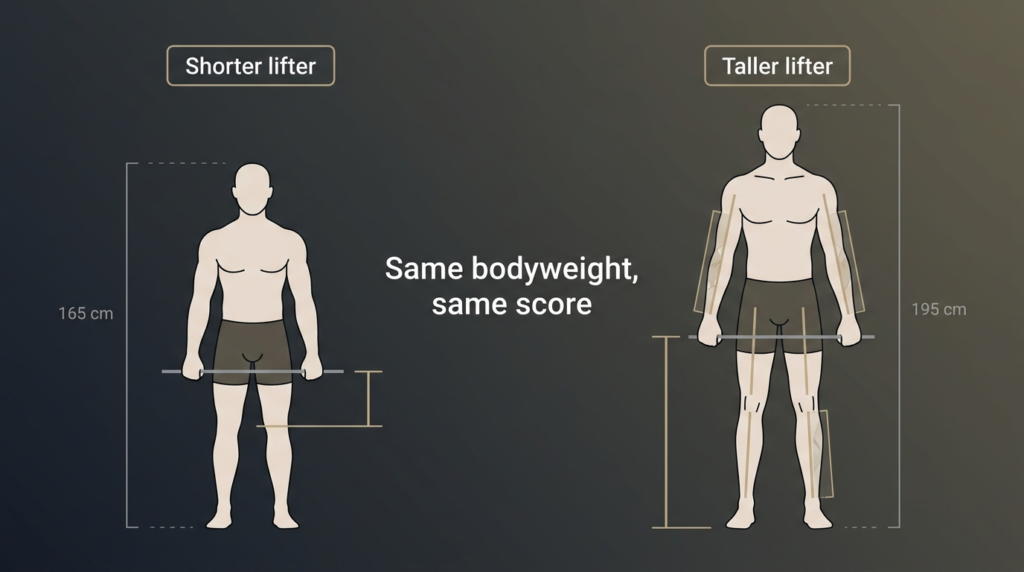
Why these factors are not included
Adding things like height, limb length, or body composition would make scoring more complex. It would require measuring these factors at every meet. That creates problems with accuracy and consistency. Because of this, no federation has added them to scoring formulas. So, the formulas only use body weight and total by design.
A full comparison of all three scoring systems helps you see the differences. It shows how each formula handles these tradeoffs in its own way.
Does accuracy matter for gym lifters?
For lifters who track their score as a personal benchmark, small formula biases matter very little. The number moves in the right direction when your relative strength improves. That is all most non-competitive lifters need from it.
Formula accuracy matters most in competition. Sometimes, the gap between first and second place is tiny. At that level, even a tiny difference in scoring can decide the winner. That is why the formula a federation uses can change who wins. Tracking your score over time is more important than a single result. Using the same calculator regularly shows your real progress. The trend matters more than which formula you use.
Use the trend, not the number
A score of 387 means very little on its own. A score that moved from 340 to 387 over 12 months of training means a great deal. The accuracy of the formula matters less than the consistency of how you measure progress. Understanding score ranges helps you see where you stand. It puts your progress into context. It also shows if you are on track compared to other lifters.
Frequently asked questions
Is DOTS more accurate than Wilks?
Yes. DOTS was built on more modern data and produces fairer scores across extreme bodyweights. The original Wilks formula has documented biases at very light and very heavy bodyweights.
Does DOTS account for height?
No. DOTS adjusts for bodyweight only. Height, limb length, and body composition are not part of the formula.
Why did Wilks score poorly in the 2020 study?
The original Wilks formula used limited 1995 data. It lacked enough very light, very heavy, and female lifters. Because of this, the results were not balanced. Newer formulas use larger and more recent data, so they give more accurate results.
Is IPF GL more accurate than DOTS?
Within IPF competition data, yes. IPF GL ranked first in the 2020 evaluation. Outside IPF data, DOTS performs more consistently across all federation contexts.
Does formula accuracy affect my training?
No. The training goal is always the same: increase your total and manage your bodyweight. A stronger total improves your score under every formula.
The Real Takeaway
No scoring formula is perfect. DOTS is the most balanced option available today for raw lifting across all bodyweights. Wilks is still meaningful but carries known limitations from its 1995 origins.
Use the formula your federation requires. Track your trend over time. The direction of your score matters far more than its exact number.